Archive
ColumnStore Indexes evolution from SQL Server 2012, 2014 to 2016
ColumnStore Indexes were first introduced in SQL Server 2012, and this created a new way to store and retrieve the Index or Table data in an efficient manner.
ColumnStore uses xVelocity technology that was based on Vertipaq engine, this uses a new Columnar storage technique to store data that is highly Compressed and is capable of In-memory Caching and highly parallel data scanning with Aggregation algorithms.
ColumnStore or Columnar data format does not store data in traditional RowStore fashion, instead the data is grouped and stored as one column at a time in Column Segments.
The Traditional RowStore stores data for each row and then joins all the rows and store them in Data Pages, and is still the same storage mechanism for Heap and Clustered Indexes.
Thus, a ColumnStore increases the performance by reading less data that is highly compressed, and in batches from disk to memory by further reducing the I/O.
–> To know more about ColumnStore Indexes check [MSDN BoL].
–> Let’s see the journey of ColumnStore index from SQL Server 2012 to 2016:
✔ We will start with SQL Server 2012 offering for ColumnStore Indexes:
1. A Table (Heap or BTree) can have only one NonClustered ColumnStore Index.
2. A Table with NonClustered ColumnStore Index becomes readonly and cannot be updated.
3. The NonClustered ColumnStore Index uses Segment Compression for high compression of Columnar data.
✔ With SQL Sever 2014 some new features were added, like:
1. You can create one Clustered ColumnStore Index on a Table, and no further Indexes can be created.
2. A Table with Clustered ColumnStore Index can be updated with INSERT/UPDATE/DELETE operations.
3. Both Clustered & NonClustered ColumnStore Index has new Archival Compression options i.e. COLUMNSTORE_ARCHIVE to further compress the data.
✔ Now with SQL Server 2016 new features have been added and some limitations are removed:
1. A Table will still have one NonClustered ColumnStore Index, but this will be updatable and thus the Table also.
2. Now you can create a Filtered NonClustered ColumnStore Index by specifying a WHERE clause to it.
3. A Clustered ColumnStore Index table can have one or more NonClustered RowStore Indexes.
4. Clustered ColumnStore Index can now be Unique indirectly as you can create a Primary Key Constraint on a Heap table (and also Foreign Key constraints).
5. Columnar Support for In-Memory (Hekaton) tables, as you can create one one ColumnStore Index on top of them.
–> Here is the full feature summary of ColumnStore Indexe evolution from SQL Server 2012 to 2016:

–> Check more about this on [MSDN BoL].
Check the above details explained in the video below:
Now truncate “Table Partitions” with TRUNCATE TABLE statement – SQL Server 2016
TRUNCATE TABLE has got a new definition now!!!
Now with SQL Server 2016 as per MSDN BoL: “TRUNCATE TABLE removes all rows from a Table or Specified Partitions of a Table, without logging the individual row deletions”.
This is kind of a filtration to TRUNCATE TABLE statement at a Partition level, just like a WHERE clause option with DELETE TABLE statement at a Row level.
With previous versions ( SQL Server 2014 and back) you could only Truncate a whole Table, but not its Partition.
–> You can now use a WITH PARTITIONS() option with TRUNCATE TABLE statement to truncate Table Partition(s) like:
TRUNCATE TABLE dbo.PartitionedTable
WITH (PARTITIONS (2, 4, 6 TO 8))
MSDN reference for [TRUNCATE TABLE]
Check my [previous post] on differences between TRUNCATE & DELETE statements.
See Execution Plans running with Live Query Statistics – SQL Server 2016
In SQL Server 2016 Live Query Statistics is going to be the most used feature among Developers & DBAs to check the live Execution Plan of an active Query running in parallel.
The Live Query/Execution Plan will provide Real-time insights into the Query Execution process as the Control flows from one Operator to the another. It will display the overall Query Progress and Operator-level Run-time Execution Stats such as:
1. Number of Rows processed
2. Completion Estimate
3. Operator progress – Elapsed time & Percentage done for each Operator
4. Elapsed time & Percentage done for overall Query progress
–> The feature can be enable from the Toolbar, just besides the “Actual Execution Plan” icon:

–> The Live Execution plan running can be seen in below animated image:
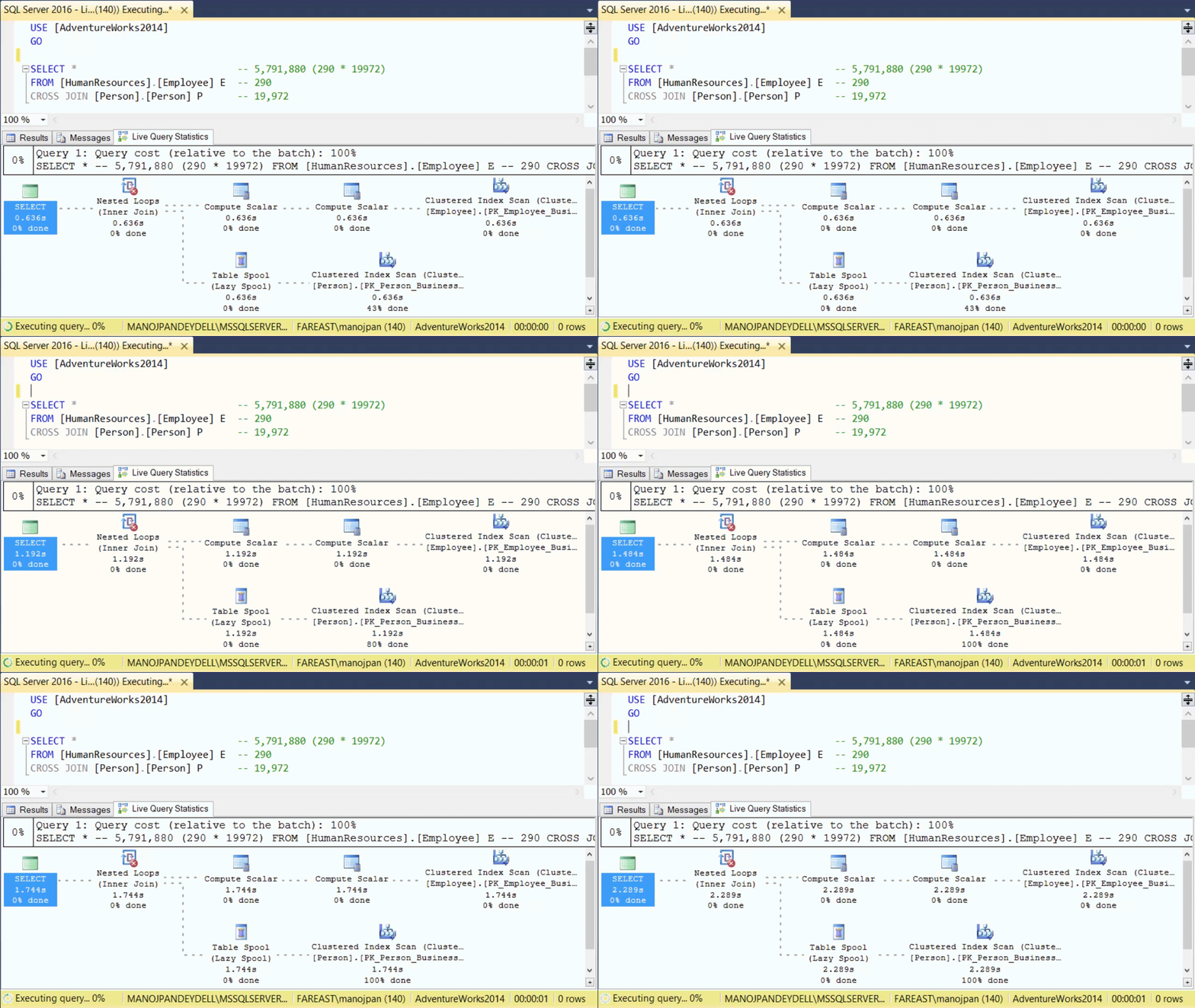
The dotted moving lines above shows the Operators currently in execution. As soon as the Operator finishes execution these dotted lines will change to solid lines.
Thus, by using this feature the user will not have to wait for a Query to complete its execution and then see the Execution plan stats. As soon as the user will run the Query, the Live Execution Plan will also start showing all the Operators and their progress. This will help users in checking the long running queries where actually they are taking time, and help debugging Query performance issues.
You can also check the full demo here in this video:
Enable Query Store on a Database – SQL Server 2016
… continuing from my [previous post] on Query Store.
Here we will see how can we enable it on a Database:
–> Right click on the Database you want to enable Query Store and select Properties. Now select the new feature Query Store at the bottom left side as shown below:

Set the Enable option to True, and click OK.
–> Alternative: You can also enable the Query Store by this simple ALTER DATABASE Statement:
USE [TestManDB]
GO

ALTER DATABASE [TestManDB] SET QUERY_STORE = ON
GO
–> After enabling the Query Store you can check the Database, expand it in Object Explorer, you will see a new folder with the same name “Query Store”, on expanding it you will see 4 reports, as shown in below snapshot:

–> You can check more about Query Store on MSDN BoL [here] with more coverage on what information/stats it captures and how you can Query them.
Export/Convert Table or SQL Query data to JSON string format | SQL Server 2016 – Part 1
In my [previous post] we saw JOSN added as a new feature in SQL Server 2016.
–> Just like XML now you can also:
1. Store JSON data in SQL Server in table columns as NVARCHAR datatype.
2. Export SQL tables rows to JSON data.
3. Query external JSON data and store back in SQL tables.
–> Note:
– With this CTP2 release you can only export data as JSON string.
– But with the release of CTP3 you will also be able to read JSON data by T-SQL query and convert it into tabular (row/column) format, and will support indexes.
–> Just like XML for exporting JSON data you can use FOR JSON [AUTO | PATH] syntax:
1. FOR JSON AUTO: option automatically creates a nested JSON data with sub arrays based on the table hierarchy used in the Query. The AUTO option must have a FROM clause.
2. FOR JSON PATH: option enables you to define the structure of output of JSON data using the column names with aliases by using a dot separator.
–> Let’s see how export to JSON works:
– I’ll create a sample table and insert few rows in it:
CREATE TABLE Students (
	ID INT IDENTITY(1,1) NOT NULL,
	FirstName VARCHAR(255),
	LastName VARCHAR(255),
	Class INT,
	Marks DECIMAL(3,1)
)

INSERT INTO Students (FirstName, LastName, Class, Marks)
SELECT 'Manoj',   'Pandey', 10, 80.5
UNION ALL
SELECT 'Saurabh', 'Sharma', 11, 82.7
UNION ALL
SELECT 'Kanchan', 'Pandey', 10, 90.5
1. Let’s check the “FOR JSON AUTO” option:
SELECT ID, FirstName, LastName, Class, Marks
FROM Students
FOR JSON AUTO -- here
– Output with AUTO option:

– Output with AUTO and ROOT() option:
SELECT ID, FirstName, LastName, Class, Marks
FROM Students
FOR JSON AUTO, ROOT('StudList') -- here
– This is how a formatted JSON looks like:
{
  "StudList": [
    {
      "ID": 1,
      "FirstName": "Manoj",
      "LastName": "Pandey",
      "Class": 10,
      "Marks": 80.5
    },
    {
      "ID": 2,
      "FirstName": "Gaurav",
      "LastName": "Pandey",
      "Class": 11,
      "Marks": 82.7
    },
    {
      "ID": 3,
      "FirstName": "Garvit",
      "LastName": "Pandey",
      "Class": 10,
      "Marks": 90.5
    }
  ]
}
This option as mentioned previously formats the JSON document automatically based upon the columns provided in the Query.
2. Now let’s check the “FOR JSON PATH” option: with this option you can use the dot syntax as used in below Query to form a nested output.
SELECT
	ID,
	FirstName AS "StudentName.FirstName",
	LastName AS "StudentName.LastName",
	Marks
FROM Students
FOR JSON PATH -- here
– Output with PATH option:
[
   {
      "ID":1,
      "StudentName":{
         "FirstName":"Manoj",
         "LastName":"Pandey"
      },
      "Marks":80.5
   },
   {
      "ID":2,
      "StudentName":{
         "FirstName":"Saurabh",
         "LastName":"Sharma"
      },
      "Marks":82.7
   },
   {
      "ID":3,
      "StudentName":{
         "FirstName":"Kanchan",
         "LastName":"Pandey"
      },
      "Marks":90.5
   }
]
As you can see with PATH option you can create wrapper objects (here “StudentName”) and nest properties (here “FirstName” & “LastName”).
–> You can also check this demo in this video:
With the current release of CTP2 here you saw how we can export a SQL Table rows to JSON data. As soon as CTP3 will release we will see how can we read data back from from JSON string and convert it to tabular (row/column) format.
–> Check my [next post] on how to Import/Read JSON string and convert it in rational-tabular format in form of rows/columns.
Check more about JSON support on [MSDN BoL].



Current Visitors

StatCounter …since April 2012


 Leisure blog: Creek & Trails
- NMDC Hyderabad Marathon – My first 42k FM, cramps, training and fuelling
- Singapore (Part 2) – 6 days itinerary, sightseeing & attractions
- Singapore (Part 1) – Tickets, Visa, Hotel, Forex Card/Cash, Metro/Bus cards
- I got full refund of my flight tickets during COVID lockdown (AirIndia via MakeMyTrip)
- YouTube – Your Google Ads account was cancelled due to no spend
- YouTube latest update on its YPP (YouTube Partner Program) which may affect your channel
- Starting your own blog !!!
- How to file ITR (Income Tax Return) online AY 2017-18 (for simple salaried)
- Scam – Become a kin/hier and earn a fortune – via LinkedIn and Email
- Places to visit in and around Vizag (aka Visakhapatnam)
 SQL with Manoj