Archive
New THROW statement in SQL Server 2012 (vs RAISERROR)
Newly introduced THROW keyword in SQL server 2012 is an improvement over the existing RAISERROR() statement. Yes, it’s single ‘E’ in RAISERROR.
Both RAISERROR & THROW can be used in T-SQL code/script to raise and throw error within a TRY-CATCH block. Check my previous post for TRY-CATCH block, [link].
–> With RAISERROR developers had to use different ERROR_xxxx() system functions to get the error details to pass through the RAISERROR() statement, like:
– ERROR_NUMBER()
– ERROR_MESSAGE()
– ERROR_SEVERITY()
– ERROR_STATE()
let’s see an example:
-- Using RAISERROR()
DECLARE
	@ERR_MSG AS NVARCHAR(4000)
	,@ERR_SEV AS SMALLINT
	,@ERR_STA AS SMALLINT

BEGIN TRY
	SELECT 1/0 as DivideByZero
END TRY
BEGIN CATCH
	SELECT @ERR_MSG = ERROR_MESSAGE(),
		@ERR_SEV =ERROR_SEVERITY(),
		@ERR_STA = ERROR_STATE()
	SET @ERR_MSG= 'Error occurred while retrieving the data from database: ' + @ERR_MSG

	RAISERROR (@ERR_MSG, @ERR_SEV, @ERR_STA)  WITH NOWAIT
END CATCH
GO
Output:
(0 row(s) affected)
Msg 50000, Level 16, State 1, Line 15
Error occurred while retrieving the data from database: Divide by zero error encountered.
The RAISERROR() can take first argument as message_id also instead of the message. But if you want to pass the message_id then it has to be in sys.messages
–> With THROW the benefit is: it is not mandatory to pass any parameter to raise an exception.
Just using the THROW; statement will get the error details and raise it, as shown below:
-- Using THROW - 1
BEGIN TRY
	SELECT 1/0 as DivideByZero
END TRY
BEGIN CATCH
	THROW;
END CATCH
GO
Output:
(0 row(s) affected)
Msg 8134, Level 16, State 1, Line 2
Divide by zero error encountered.
As you see in the Output above, the error message thrown is the default one. But you can also add your customized message, we will see below.
IMP NOTE: THROW will show the exact line where the exception was occurred, here the line number is 2. But RAISERROR will show the line number where the RAISERROR statement was executed i.e. Line 15, but not the actual exception position.
Also passing the message_id won’t require it to be stored in sys.messages, let’s check this:
-- Using THROW - 2
DECLARE
	@ERR_MSG AS NVARCHAR(4000)
	,@ERR_STA AS SMALLINT

BEGIN TRY
	SELECT 1/0 as DivideByZero
END TRY
BEGIN CATCH
	SELECT @ERR_MSG = ERROR_MESSAGE(),
		@ERR_STA = ERROR_STATE()

	SET @ERR_MSG= 'Error occurred while retrieving the data from database: ' + @ERR_MSG;

	THROW 50001, @ERR_MSG, @ERR_STA;
END CATCH
GO
Output:
(0 row(s) affected)
Msg 50001, Level 16, State 1, Line 14
Error occurred while retrieving the data from database: Divide by zero error encountered.
But if you parameterize the THROW statement as above it will not show the actual position of exception occurrence, and the behavior will be same as RAISERROR(). As with RAISERROR() you’ve to provide mandatory params, so there is no way to get the actual position of Line where the error occurred.
As per MSBOL following are the difference between RAISERROR & THROW:
|
RAISERROR statement |
THROW statement |
|---|---|
|
If a msg_id is passed to RAISERROR, the ID must be defined in sys.messages. |
The error_number parameter does not have to be defined in sys.messages. |
|
The msg_str parameter can contain printf formatting styles. |
The message parameter does not accept printf style formatting. |
|
The severity parameter specifies the severity of the exception. |
There is no severity parameter. The exception severity is always set to 16. |
NOTE: As per MS BOL for exception handling in new development work THROW must be used instead of RAISERROR.
SQL Server 2012 does not support Linked Server to SQL Server 2000, workaround
Yes, you read it right, “SQL Server 2012” has stopped connecting to “SQL Server 2000” via linked Servers. As this new version uses a new Native Client version i.e. SQLNCLI11, instead of the old SQLNCLI10. This new client only connects back to 2008R2, 2008 and 2005 only.
– I upgraded my Database Servers from “SQL Server 2008 R2” to “SQL Server 2012”.
– Restored the databases from the backup taken from 2008R2.
– Ran the jobs and found that one of them was failing with following error:
Error Message:
OLE DB provider “SQLNCLI11” for linked server “NorthWind2000” returned message “Client unable to establish connection”.
Msg 22, Level 16, State 1, Line 0
SQL Server Native Client 11.0 does not support connections to SQL Server 2000 or earlier versions.
OLE DB provider “SQLNCLI11” for linked server “NorthWind2000” returned message “Invalid connection string attribute”.
As I have upgraded from 2008 R2, so I checked Providers under the Linked Server and found that with the new SQLNCLI11, I still have the “SQL Server Native Client 10.0” i.e. “SQLNCLI10”.
So, I tried to create the Linked Server by using “SQLNCLI10”, but it again gave an error, as follows:
Msg 8522, Level 16, State 3, Line 1
Microsoft Distributed Transaction Coordinator (MS DTC) has stopped this transaction.
I scripted out the DDL of my existing Linked Server, as below:
USE [master]
GO

-- Existing LinkedServer [NorthWind2000]:
EXEC sp_addlinkedserver	@server = N'NorthWind2000',
						@srvproduct=N'MSSQL',
						@provider=N'SQLNCLI',
						@provstr=N'PROVIDER=SQLOLEDB;SERVER=NorthWind'

EXEC sp_addlinkedsrvlogin   @rmtsrvname=N'NorthWind2000',
							@useself=N'True',
							@locallogin=NULL,
							@rmtuser=NULL,
							@rmtpassword=NULL
GO
=> WORKAROUND / FIX:
Now as a workaround to make this Linked Server work we have an option to use the ODBC Data Source which will connect to our remote server.
There are 2 approaches:
1. Either we create an ODBC Data Source (DSN) and use it in our Linked Server.
2. Or, use the Data Source (DSN) connection string directly in the Linker Server Provider.
–> Using appraoch #1:
Create an ODBC Data Source:
1. Open Control Panel, go to Administrative Tools, then “Data Sources (ODBC)”.
2. On “ODBC Data Source Administrator” window go to “System DSN” Tab.
3. Here click on Add to create a new DSN.
4. Choose “SQL Server” and click Finish.
5. On the new window, give a proper name for the Source DSN (like: NorthWind2000DSN), we will use this name while creating our Linked Server. Provide the Server name which is on SQL Server 2000, here “NorthWind”. Click Next.
6. Choose the Authentication Type, either Windows or SQL Server auth. Click Next.
7. Change the default database, not necessary. Click Next.
8. Click Finish. You will see a new DSN created under System DSN tab.
Now, create Linked Server and provide this DSN in the @datasrc param and provide the @provider param “MSDASQL”.
You can use the below query to create the same:
USE master
GO
-- Drop Existing LinkedServer [NorthWind2000]:
EXEC sp_dropserver @server=N'NorthWind2000', @droplogins='droplogins'
GO

-- Re-create LinkedServer [NorthWind2000] by using the ODBC connection:
EXEC sp_addlinkedserver @server = N'NorthWind2000',
						@srvproduct=N'MSDASQL',
						@provider=N'MSDASQL',
						@datasrc = N'NorthWind2000DSN',
						@location=N'System';

EXEC sp_addlinkedsrvlogin @rmtsrvname=N'NorthWind2000',
						  @useself=N'True',
						  @locallogin=NULL,
						  @rmtuser=NULL,
						  @rmtpassword=NULL
GO
–> Using appraoch #2:
We can also directly put the DSN connection String in the Provider String @provstr param.
Let’s check it below:
USE master
GO
-- Drop Existing LinkedServer [NorthWind2000]:
EXEC sp_dropserver @server=N'NorthWind2000', @droplogins='droplogins'
GO
-- Re-create LinkedServer [NorthWind2000] by using the ODBC connection:
EXEC sp_addlinkedserver @server = N'NorthWind2000',
						@srvproduct=N'',
						@provider=N'MSDASQL',
						@provstr=N'DRIVER={SQL Server};SERVER=NorthWind;Trusted_Connection=yes;'

EXEC sp_addlinkedsrvlogin @rmtsrvname=N'NorthWind2000',
						  @useself=N'True',
						  @locallogin=NULL,
						  @rmtuser=NULL,
						  @rmtpassword=NULL
GO
This way you can query SQL Server 2000 data from SQL Server 2012 via Linked Servers by using ODBC DSN.
This seems seamless but it is an indirect process and a workaround to query SQL Server 2000 database.
To make your queries or ETLs efficient it is advisable to upgrade to a higher version, at-least SQL Server 2005.
>> Check & Subscribe my [YouTube videos] on SQL Server.
SQL Server vNext (2012) coming up with lot a new features | Hekaton, Polybase, PDW, and many more
This year’s PASS Summit Microsoft announced lot of new features coming up for “SQL Server 2012” and version vNext.
1. Released SQL Server 2012 Service Pack 1: with bug fixes and lot of improvements, like Selective XML Indexes & enhancements in Self-Service BI & Excel 2013.

2. Column Store Indexes: will be extended to be created with Clustered Indexes as well.
3. Hekaton & Polybase: will be major ingredients in SQL Server vNext by 2014-15.
4. SQL Server version Next: will use Hekaton for its OLTP database to take database objects into in-memory and “memory optimize” tables, thus challenging SAP-Hana and Oracle much hyped Exadata soluition.
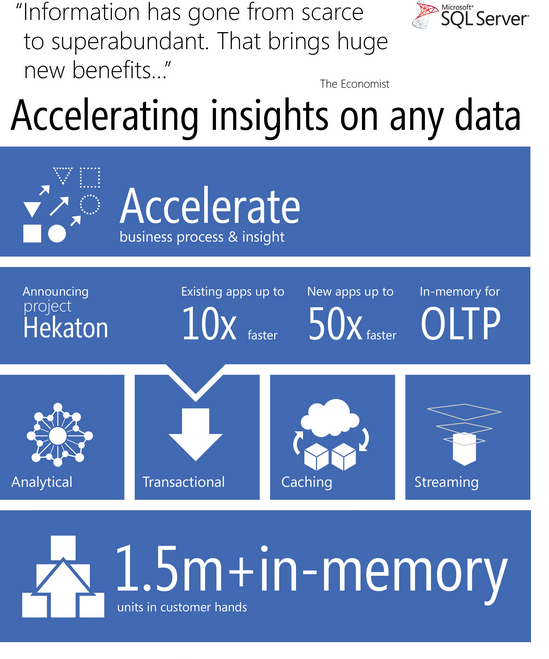
5. SQL Server 2012 PDW: (Parallel Data Warehouse) will be using Polybase to interact between PDW and Hadoop clusters.

… I’ll be discussing more about these things in next posts, so keep tuned!!!
SQL Server 2012 | Temp Tables are created with negative Object IDs
These days I’m working on SQL Server upgrade from 2008 R2 to 2012 for one of our project module.
Today while working on it I got blocked while installing a Build. The build was failing with following error:
Error SQL72014: .Net SqlClient Data Provider: Msg 2714, Level 16, State 6, Line 115 There is already an object named ‘#temp’ in the database.
I checked the code and found the line where it was failing:
IF object_id('tempdb.dbo.#temp') > 0
       DROP TABLE #temp
I checked this code with SQL Server 2008 R2 and it was working perfectly.
So to check and validate this I created a temp-table on SQL Server 2012 and found that it is created by negative Object ID, check this:

This is a new change done with SQL 2012 version, but this is not mentioned anywhere in MSDN BOL.
So, to make this legacy code work we have to re-factor all such cases, by:
IF object_id('tempdb.dbo.#temp') IS NOT NULL
       DROP TABLE #temp
Confirmation form Microsoft SQL team blog [CSS SQL Server Engineers]:
“in SQL Server 2012, we made a conscious change to the algorithm so that objectids for user-defined temporary tables would be a particular range of values. Most of the time we use hex arithmetic to define these ranges and for this new algorithm these hex values spill into a specific set of negative numbers for object_id, which is a signed integer or LONG type. So in SQL Server 2012, you will now always see object_id values < 0 for user-defined temp tables when looking at a catalog view like sys.objects.”
More Info on: http://blogs.msdn.com/b/psssql/archive/2012/09/09/revisiting-inside-tempdb.aspx
Passed 70-461 Exam : Querying Microsoft SQL Server 2012
Yesterday (Nov 15th 2012) I went through this exam and passed it. From long back I was looking an opportunity to give at least a single SQL Server Certification Exam to check my worth.
Just a week back I scheduled a slot for this Exam (for yesterday). I was looking for some reading material for the same but I couldn’t get any. Though there is a book from Microsoft Press i.e. “Training Kit (Exam 70-461): Querying Microsoft SQL Server 2012
As I maintain this blog on SQL Server and also evangelize on SQL Server 2012 latest features from long back, so I thought to give it a try and wow I went thru in a single shot!!!
Here by this post I want to provide my readers some information and knowledge about this Exam, so that they can plan well for this and look forward to take up this exam.
–> Exam Highlights:
– There were total 54 Questions
– Total time to attempt the paper was 3 Hrs.
– Total Marks: 1000
– Passing Marks: 700
– The Questions in the Exam were:
1. Mostly Objective Type.
2. Some were Subjective: where you’ve to write code, like SELECT statement and/or View Definition, etc.
3. And very few were Multiple Choice.
4. A few Question were where you’ve to pick up the appropriate code snippet and arrange them in correct sequence.
–> The Exam is divided into 4 modules:
1. Create Database Objects | 24%
– CREATE/ALTER/DROP Database, [link], [video]
– CREATE/ALTER/DROP Table, [link], [video]
– ADD/DROP/Rename table’s Columns, [video]
– Data Types [video]:
– – (XML, DATETIME, SPATIAL, VARCHAR)
– Constraints [link], [video]
– – (Primary Key, Unique Key, Foreign Key, NOT NULL, Check, Default)
– Computed Columns [video]:
– Views [link]
– Indexed Views (SCHEMABINDING, COUNT_BIG(*), CLUSTERED INDEX)
– Stored Procedures, [link].
– DML Triggers (INSERTED, UPDATED, UPDATE function) vs CHECK Constraint
– TRIGGER for VIEWS (INSTEAD OF)
– UDF (Functions), [link].
– SP vs UDF, [link].
2. Work with Data | 27%
– New Functions in SQL Server 2012 (IFF, TRY_PARSE, CONCAT, FORMAT), [link].
– FETCH-OFFSET, [link].
– SEQUENCE, [link].
– Ranking Functions (ROW_NUMBER, RANK, DENSE_RANK, NTILE), [link], [video].
– OVER() Window Function, [link]
– JOINS (INNER, OUTER LEFT, OUTER RIGHT, CROSS), [link].
– APPLY Operators (CROSS APPLY vs OUTER APPLY), [link].
– CTE and Sub-Queries, [link].
– PIVOT, [link].
– ROLLUP, CUBE & GROUPING SETS, [link].
– Dynamic SQL
– ANY, SOME, ALL
– CASE vs ISNULL vs COALESCE, [link].
– FOR XML RAW/AUTO/PATH [ELEMENTS], [link].
– Implementing XML Schemas and Handling of XML data
3. Modify Data | 24%
– Stored Procedure (with EXECUTE AS, RECOMPILE)
– MERGE Statement (TARGET, SOURCE, WHEN MATCHED, WHEN NOT MATCHED, OUTPUT), [link].
– EXCEPT vs INTERSECT
– UNION vs UNION ALL, [link].
– SCALAR vs TABLE Valued Functions.
– Use of APPLY with UDFs, [link].
– VARCHAR(MAX) and .WRITE(), [link].
4. Troubleshoot & Optimize | 25%
– Using Statistics
– SQL Internal JOINS (NESTED – Small, MERGE – Large Sorter, HASH – Large Unsorted), [link].
– TRANSACTIONS (BEGIN, COMMIT, ROLLBACK, XACT_ABORT, TRANCOUNT), [link].
– ISOLATION Levels (READ UNCOMMITTED, READ COMMITTED, REPEATABLE READ, SNAPSHOT, SERIALIZABLE)
– TRY/CATCH, [link].
– RAISE vs THROW [link]
– CURSORS (Row-Based) vs SET Based Approach
– Table Hints (UPDLOCK, ROWLOCK, TABLOCK, …etc)
– Query Hints (OPTION (OPTIMIZED FOR … [UNKNOWN]))
For “SQL Server 2014” exam certification check here.
–> You can check following Study materials to prepare for this Exam:
Microsoft Link for this Certification: https://www.microsoft.com/learning/en-us/exam-70-461.aspx
Books on AMAZON.com:
– Training Kit (Exam 70-461): Querying Microsoft SQL Server 2012
– Microsoft SQL Server 2012 T-SQL Fundamentals
–> Download “SQL Server 2014 Express” (free) version to practice T-SQL Queries:
Join SQL Server 2016 groups on [LinkedIn] and [Facebook] for more updates.
All The Best!!!



Current Visitors

StatCounter …since April 2012


 Leisure blog: Creek & Trails
- NMDC Hyderabad Marathon – My first 42k FM, cramps, training and fuelling
- Singapore (Part 2) – 6 days itinerary, sightseeing & attractions
- Singapore (Part 1) – Tickets, Visa, Hotel, Forex Card/Cash, Metro/Bus cards
- I got full refund of my flight tickets during COVID lockdown (AirIndia via MakeMyTrip)
- YouTube – Your Google Ads account was cancelled due to no spend
- YouTube latest update on its YPP (YouTube Partner Program) which may affect your channel
- Starting your own blog !!!
- How to file ITR (Income Tax Return) online AY 2017-18 (for simple salaried)
- Scam – Become a kin/hier and earn a fortune – via LinkedIn and Email
- Places to visit in and around Vizag (aka Visakhapatnam)
 SQL with Manoj