SQL Server 2012 (a.k.a Denali) – New feature | WITH RESULT SETS
“WITH RESULT SETS”, a new feature added in SQL Server 2012 allows us to tweak the Column Names and their Datatypes returned by an SP upon executed as per our needs. In SQL Server 2012 while calling an SP you can add the “WITH RESULT SETS” option and can provide the new Column Names and/or with new Datatypes with the parenthesis as per your wish (shown below).
Prior to this if one has to do the same, he has to either:
– Edit the same SP with new column names, or
– Create a new duplicate SP with different column headers, or
– Push records to a temp table first then use the records set form that table (discussed in later part of this post).
Let’s check this new feature by a simple example here by using a Stored Procedure from [AdventureWorks2012] database for SQL Server 2012:
USE [AdventureWorks2012]
GO

-- Normal SP call without using "WITH RESULT SETS" option:
EXEC [dbo].[uspGetEmployeeManagers] @BusinessEntityID = 100
Recordset with same headers as in SP:

RecursionLevel	BusinessEntityID	FirstName	LastName	OrganizationNode	ManagerFirstName	ManagerLastName
0		100			Lolan		Song		/3/1/9/7/		Kok-Ho			Loh
1		93			Kok-Ho		Loh		/3/1/9/			Peter			Krebs
2		26			Peter		Krebs		/3/1/			James			Hamilton
3		25			James		Hamilton	/3/			Ken			Sánchez
-- This is how you can use the new option and get desired headers:
EXEC [dbo].[uspGetEmployeeManagers] @BusinessEntityID = 100
WITH RESULT SETS
(
	(
	Level INT,
	BusinessID INT,
	EmpFirstName VARCHAR(50),
	EmpLastName VARCHAR(50),
	OrgNode VARCHAR(20),
	ManagerFirstName VARCHAR(50),
	ManagerLastName VARCHAR(50)
	)
)
Recordset with new headers as in SP:

Level	BusinessID	EmpFirstName	EmpLastName	OrgNode		ManagerFirstName	ManagerLastName
0	100		Lolan		Song		/3/1/9/7/	Kok-Ho			Loh
1	93		Kok-Ho		Loh		/3/1/9/		Peter			Krebs
2	26		Peter		Krebs		/3/1/		James			Hamilton
3	25		James		Hamilton	/3/		Ken			Sánchez
–> Traditonal appraoch prior to ver. 2012
-- Create a table with columns with required names:
CREATE TABLE #tempData (
	Level INT,
	BusinessID INT,
	EmployeeFirstName VARCHAR(50),
	EmployeeLastName VARCHAR(50),
	OrgNode VARCHAR(20),
	ManagerFirstName VARCHAR(50),
	ManagerLastName VARCHAR(50)
	)

-- Insert records from the SP to the table:
INSERT INTO #tempData (Level, BusinessID, EmployeeFirstName, EmployeeLastName, OrgNode, ManagerFirstName, ManagerLastName)
EXEC @return_value = [dbo].[uspGetEmployeeManagers] @BusinessEntityID = 100

-- Finaly select the table and use the records:
SELECT * FROM #tempData

-- Final Cleanup:
DROP TABLE #tempData
GO
Well this is OK, but not very exciting feature for me as a developer.
I was hoping this would allow me to add/remove the columns and/or Concatenate them, like FirstName & LastName to FullName, but No!!!
For more information you can check MS BOL, here: http://msdn.microsoft.com/en-us/library/ms188332(v=sql.110).aspx
‘NOCHECK’ vs ‘WITH NOCHECK’… while creating disabled Foreign Key (FK) constraint
I dicussed about disabling FK constraints in one of my previous post to UPDATE/DELETE records to avoid some conflicts, check this [link] for more info.
There is an option while adding a Constraint to a table:
-- Syntax:
ALTER TABLE TABLE_NAME WITH NOCHECK
ADD CONSTRAINT FK_CONSTRAINT_NAME FOREIGN KEY(COL_NAME_ID)
REFERENCES OTHER_REF_TABLE (OTHER_TABLE_COL_NAME_ID)
But this doesn’t disable the FK constraint, instead it creates the FK constraint without checking existing records.
You will need to issue a separate ALTER TABLE statement to disable the FK constraint:
-- Syntax:
ALTER TABLE TABLE_NAME NOCHECK CONSTRAINT FK_CONSTRAINT_NAME
So, what’s the difference here when we apply ‘WITH NOCHECK’ vs ‘NOCHECK’?
Let’s check this by taking the [Sales].[SalesOrderDetail] table from AdventureWorks database:
USE [AdventureWorks2008R2]
GO

-- Here I just created the script of [Sales].[SalesOrderDetail] table and stripped off the unwanted parts and changed the table name to [Sales].[SalesOrderDetailTemp]
CREATE TABLE [Sales].[SalesOrderDetailTemp](
	[SalesOrderID] [int] NOT NULL,
	[SalesOrderDetailID] [int] IDENTITY(1,1) NOT NULL,
	[CarrierTrackingNumber] [nvarchar](25) NULL,
	[OrderQty] [smallint] NOT NULL,
	[ProductID] [int] NOT NULL,
	[SpecialOfferID] [int] NOT NULL,
	[UnitPrice] [money] NOT NULL,
	[UnitPriceDiscount] [money] NOT NULL,
	[rowguid] [uniqueidentifier] ROWGUIDCOL NOT NULL,
	[ModifiedDate] [datetime] NOT NULL,
 CONSTRAINT [PK_SalesOrderDetailTemp_SalesOrderID_SalesOrderDetailID]
 PRIMARY KEY CLUSTERED (
	[SalesOrderID] ASC,
	[SalesOrderDetailID] ASC
)WITH (PAD_INDEX = OFF, STATISTICS_NORECOMPUTE = OFF, IGNORE_DUP_KEY = OFF, ALLOW_ROW_LOCKS = ON, ALLOW_PAGE_LOCKS = ON) ON [PRIMARY]
) ON [PRIMARY]
GO

-- Let's create a FK constraint with 'WITH NOCHECK' option
ALTER TABLE [Sales].[SalesOrderDetailTemp]
	WITH NOCHECK
	ADD CONSTRAINT [FK_SalesOrderDetailTemp_SalesOrderHeader_SalesOrderID] FOREIGN KEY([SalesOrderID])
	REFERENCES [Sales].[SalesOrderHeader] ([SalesOrderID])
ON DELETE NO ACTION
GO
Now, go to Object Explorer check the Table -> Keys. Right click on the FK and select Modify. Check the following option on the FK Relationship popup box:
– General -> Check existing data on Creation or Re-Enabling = No
– Table Designer -> Enforce foreign key constraint = Yes
This shows that the FK constriant is still enabled but it didn’t validated the existing records while creating the FK.
Now to really disable the FK we will just have to use the NOCHECK option without using the WITH keyword:
ALTER TABLE [Sales].[SalesOrderDetailTemp]
	NOCHECK CONSTRAINT [FK_SalesOrderDetailTemp_SalesOrderHeader_SalesOrderID]
GO
Now, check again the Table -> Keys in Object Explorer. You will see the second option ‘Enforce foreign key constraint’ has changed to ‘No’ in the FK Relationship popup box.
-- Final cleanup
DROP TABLE [Sales].[SalesOrderDetailTemp]
GO
So, finally we saw the difference in using the NOCHECK option by using ‘WITH’ and without ‘WITH’ keyword.
And you cannot directly add a Disabled Constraint to a table. You will need to create the FK Constraint first then only you can disable it by using another ALTER TABLE statement.
SQL Server 2012 (a.k.a Denali) – New feature | FileTables
In my [previous posts] I discussed about new features of Denali, now SQL Server 2012.
Here, in this post I’ll talk about a new feature that I explored recently, when I was working with creating tables in SQL Server 2012. I observed a new item in object explorer that took my attention and created eagerness to explore it, and that new thing is FileTables.
As per MS BOL, The new FileTable feature brings support for the Windows file namespace and compatibility with Windows applications to the file data stored in SQL Server. FileTable lets an application integrate its storage and data management components, and provides integrated SQL Server services – including full-text search and semantic search – over unstructured data and metadata.
In other words, you can store files and documents in special tables in SQL Server called FileTables, but access them from Windows applications as if they were stored in the file system, without making any changes to your client applications. The FileTable feature builds on top of SQL Server FILESTREAM technology.
–> Let’s see how can we use this new feature by a simple example below:
USE [master]
GO

-- Create a new Database with Filestream enabled:
CREATE DATABASE [newFileStreamDB]
 CONTAINMENT = NONE
 ON  PRIMARY (
	NAME = N'newFileStreamDB',
	FILENAME = N'C:\Program Files\Microsoft SQL Server\MSSQL11.MSSQLSERVER12RC0\MSSQL\DATA\newFileStreamDB.mdf' ,
	SIZE = 5120KB ,
	MAXSIZE = UNLIMITED,
	FILEGROWTH = 1024KB
	),
 FILEGROUP newFileStreamGroup CONTAINS FILESTREAM DEFAULT (
	NAME = newFileStreamGroupFiles,
	FILENAME= 'D:\SQL_Server2012\FileTables\Files',
	MAXSIZE = UNLIMITED
	)
 LOG ON (
	NAME = N'newFileStreamDB_log',
	FILENAME = N'C:\Program Files\Microsoft SQL Server\MSSQL11.MSSQLSERVER12RC0\MSSQL\DATA\newFileStreamDB_log.ldf' ,
	SIZE = 1024KB ,
	MAXSIZE = 2048GB ,
	FILEGROWTH = 10%
	)
 WITH FILESTREAM (
	NON_TRANSACTED_ACCESS = FULL,
	DIRECTORY_NAME = N'FileTables'
	)
GO

-- Use the new Database:
USE [newFileStreamDB]
GO

-- Creating a new FileTable
CREATE TABLE [dbo].[firstFileTable]
	AS FILETABLE ON [PRIMARY]
	FILESTREAM_ON [newFileStreamGroup]
WITH (
	FILETABLE_DIRECTORY = N'myfirstFileTable',
	FILETABLE_COLLATE_FILENAME = Latin1_General_CI_AI
)
GO
So, what all objects it creates under this new FileTable:
1. The table is created with following predefined Columns:

2. with Indexes:

3. with Constraints:

4. It also creates a FK reference key:

–> Now, when checking under Object Explorer under Tables you won’t see any table (even after refreshing it). But there is a new folder named FileTables, expand it and you can see this table there, shown below:

–> Right click on it and select ‘Explore FileTable Directory’, it will open the folder as shown below:

Here, I’ve manually created 3 files, 1 notepad, 1 powerpoint and 1 word doc. You can also copy files from other locations and paste/drop them here. As you paste/drop files here, SQL Server internally updates the [firstFileTable] file table.
–> We can check the table by simply issuing SELECT statement on the table:
SELECT * FROM dbo.firstFileTable

-- Final Cleanup
DROP TABLE dbo.firstFileTable
GO
I liked this new feature very much as this will ease the work and reduce the overhead of maintaining files with databases.
In my [next post] you can check how you to use Full Text Search with files stored in FileTables.
Best Practices while creating Stored Procedures
Stored Procedures in SQL Server provides lot of benefits compared to single/multiple adhoc SQL statements. They help in achieving consistent implementation of logic across applications and improve performance. They also provides us flexibility to design desired business rules and logic by combining various SQL statements, control flow IF-ELSE statements, WHILE loops, and other programming constructs.
Thus to design them it requires a generic approach and some best practices that comes with experience as you work with them. I’m listing some of the best practices that must be followed everytime you create Stored Procedures:
1. SET NOCOUNT ON: Always use ‘SET NOCOUNT ON’ statement at the begening of your code inside the SP to reduce unnecessary network round trips.
2. PARAMETER SNIFFING: Do not use SP parameters directly within the WHERE clause of SQL statements. This may cause the case of Prameter Sniffing. To avod this assign the parameter values to local variables and then use them with SQL queries.
3. Use table variables: Try to use table variables instead of temporary tables inside the SP to cache small record sets whenever possible.
4. Use of Temp Tables: If you think that the temporary record set may exceed upto millions of rows, then try using temporary table instead of table variables. Also try creating indexes on temporary tables if required.
5. Avoid using CURSORS: This will make your SP slow and degrade the performance. Try using more effecient SET based approaches instead of using CURSORS.
6. Use TRY-CATCH block: for error handling, more info [link].
7. Using Transactions: Use Transactions by using BEGIN TRANSACTION and COMMIT/ROLLBACK TRANSACTION blocks to make sure that your actions follow ACID properties [link]. But keep the transctions as short as possible to create less blocking in database and thus avoiding deadlocks.
8. Aliasing objects: Do not use SQL Server reserve keywords while naming SQL Server objects, like for: tables, columns, views, etc. Although it allows most of the time, but its better to use other and better naming conventions.
9. Avoid GOTO stmt: Do not use GOTO statements in your code as it is considered a bad programming practice (and in every other programming language). Try comming up with a better approach/logic, use conditional IF-ELSE logic, WHILE loops and other programming constructs.
10. Avoid ‘sp_’ prefix : Do not prefix the SP name with ‘sp_’. If it begins with ‘sp_’ then the compiler will first search it in master database and then in the current one, thus delaying the execution.
11. Use fully qualified objects name: in your SQL queries, this helps in quickly finding the cached/compiled plan. Also execute the SP by using its fully qualified name, like: EXEC dbo.SPname
12. Use WITH ENCRYPTION: You can also use ‘WITH ENCRYPTION’ option while creating SP to hide the code.
13. Add Comments: Try to put comments wherever possible to give details and idea to other developers what actually your code is doing.
14. Use BEGIN-END code block: Try to bind your whole SP code within BEGIN-END block. Although it is optional but it looks good and gives a better picture.
16. Beautify your code: Well indent your code by uisng TABs, Spaces and New line (ENTER). Try going vertically downwards with your code rather expanding horizontally. This will make your code easy to read and more understandable to other developers.
17. Use following template to create your SP:
-- ================================================
-- Template generated from Template Explorer using:
-- Create Procedure (New Menu).SQL
--
-- Use the Specify Values for Template Parameters
-- command (Ctrl-Shift-M) to fill in the parameter
-- values below.
--
-- This block of comments will not be included in
-- the definition of the procedure.
-- ================================================
SET ANSI_NULLS ON
GO
SET QUOTED_IDENTIFIER ON
GO
-- =============================================
-- Author:		<Author,,Name>
-- Create date: <Create Date,,>
-- Description:	<Description,,>
-- =============================================
CREATE PROCEDURE <Procedure_Name, sysname, ProcedureName>
	-- Add the parameters for the stored procedure here
	<@Param1, sysname, @p1> <Datatype_For_Param1, , int> = <Default_Value_For_Param1, , 0>,
	<@Param2, sysname, @p2> <Datatype_For_Param2, , int> = <Default_Value_For_Param2, , 0>
AS
BEGIN
	-- SET NOCOUNT ON added to prevent extra result sets from
	-- interfering with SELECT statements.
	SET NOCOUNT ON;

    -- Insert statements for procedure here
	SELECT <@Param1, sysname, @p1>, <@Param2, sysname, @p2>
END
GO
You can also generate this template, in Object Explorer goto Database -> Programability -> Stored Procedures: Right click and select ‘New Stored Procedure…’. The above code will get generated.
>> Check & Subscribe my [YouTube videos] on SQL Server.
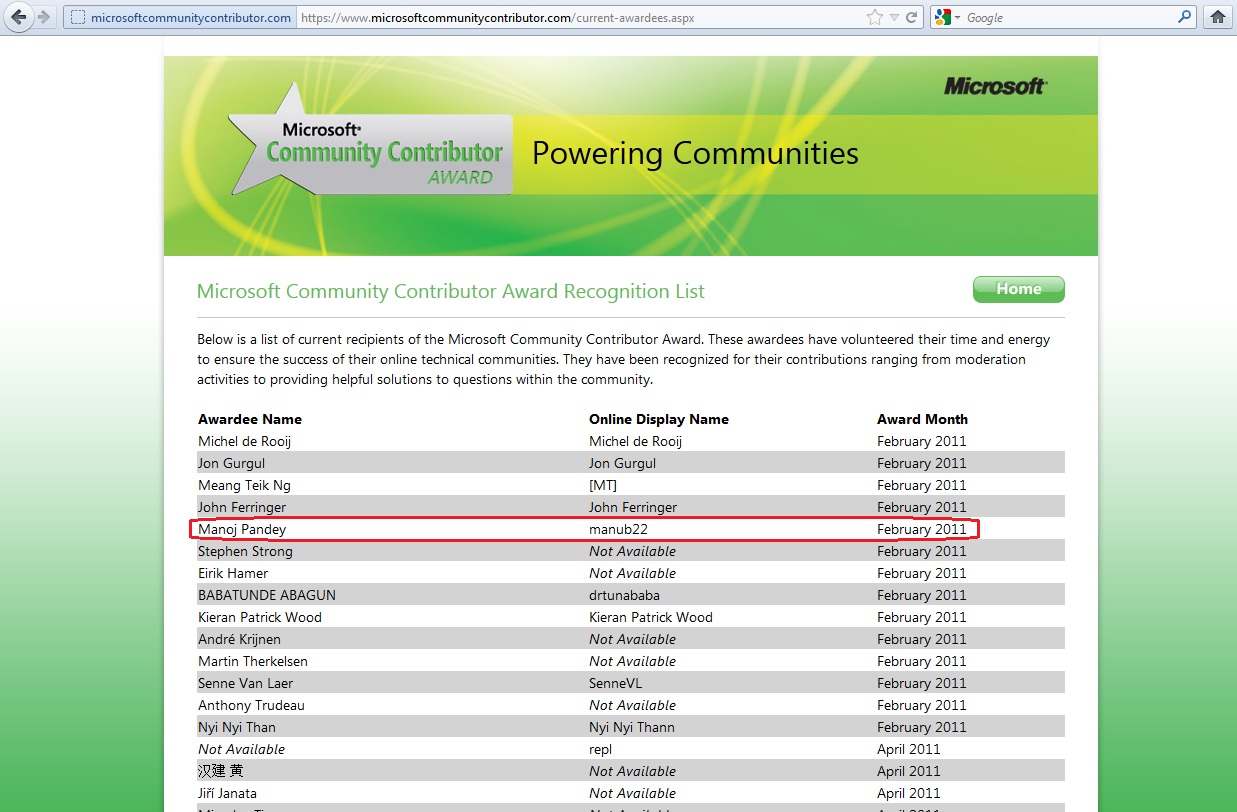
manub22 (me) on MCC 2011 awardee list
Just about a year back in Feb-2011, I was awarded by “Microsoft Community Contributor” (MCC) Award for my contributions in Microsoft’s online technical community “MSDN Transact SQL” forum. Check here for more information.
This was a kind gesture from Microsoft to award people for dedicating their precious time for the community. The award includes MCC logo, badge, Safari BOL 1 year free subscription & access to some MSDN’s knowledge bank.
Microsoft has also put a list of all awardees on their MCC site with their Names and date of award, link: https://www.microsoftcommunitycontributor.com/current-awardees.aspx
And below is the snapshot of the page where my name appears:
I started following up MSDN forums at the very start of my carrier (around mid of 2006) when I was learning SQL Server. I used to put up my queries there and was very satisfied with the kind of response I used to get. I also used to browse through other questions to see what other techies are asking & are stuck upon, and sometimes try to answer those questions. This started becoming a good learning source and encouraged me to dedicate my time here. And I remember at around year 2010 Nov-Dec I was kind of addicted to this. Now whenever I get time I check the forum and answer the questions where I can add some value.
You can see my activity and contributions on my MSDN profile at following link: http://social.msdn.microsoft.com/Profile/manub22



Current Visitors

StatCounter …since April 2012


 Leisure blog: Creek & Trails
- NMDC Hyderabad Marathon – My first 42k FM, cramps, training and fuelling
- Singapore (Part 2) – 6 days itinerary, sightseeing & attractions
- Singapore (Part 1) – Tickets, Visa, Hotel, Forex Card/Cash, Metro/Bus cards
- I got full refund of my flight tickets during COVID lockdown (AirIndia via MakeMyTrip)
- YouTube – Your Google Ads account was cancelled due to no spend
- YouTube latest update on its YPP (YouTube Partner Program) which may affect your channel
- Starting your own blog !!!
- How to file ITR (Income Tax Return) online AY 2017-18 (for simple salaried)
- Scam – Become a kin/hier and earn a fortune – via LinkedIn and Email
- Places to visit in and around Vizag (aka Visakhapatnam)
 SQL with Manoj