Archive
XTP (eXtreme Transaction Processing) with Hekaton Tables & Native Compiled Stored Procedures – SQL Server 2014
In my previous posts [this & this] I talked about creating Memory Optimized Database, how to create In-Memory Tables & Native Compiled Stored Procedures and what happens when they are created.
Here in this post we will see how FAST actually In-Memory tables & Native Compiled Stored Procedures are, when compared with normal Disk based Tables & Simple Stored Procedures.
I’ll be using the same [ManTest] database used in my previous posts, you can refer to the DDL script [here].
–> We will create:
1. One Disk based Table & one simple Stored Procedure which will use this Disk based Table.
2. One In-Memory Table & one Native Compiled Stored Procedure which will use this In-Memory Table.
1. Let’s first create a Disk based Table and a normal Stored Procedure:
USE [ManTest]
GO

-- Create a Disk table (non-Memory Optimized):
CREATE TABLE dbo.DiskTable
(
    ID INT NOT NULL
        PRIMARY KEY,
    VarString VARCHAR(200) NOT NULL,
    DateAdded DATETIME NOT NULL
)
GO

-- Create normal Stored Procedure to load data into above Table:
CREATE PROCEDURE dbo.spLoadDiskTable @maxRows INT, @VarString VARCHAR(200)
AS
BEGIN
	SET NOCOUNT ON

	DECLARE @i INT = 1

	WHILE @i <= @maxRows
	BEGIN
		INSERT INTO dbo.DiskTable VALUES(@i, @VarString, GETDATE())
		SET @i = @i+1
	END
END
GO
2. Now create an In-Memory table & a Native Compiled Stored Procedure to load data:
-- Create an In-Memory table:
CREATE TABLE dbo.MemOptTable
(
    ID INT NOT NULL
        PRIMARY KEY NONCLUSTERED HASH WITH (BUCKET_COUNT = 10000),
    VarString VARCHAR(200) NOT NULL,
    DateAdded DATETIME NOT NULL
) WITH (
	MEMORY_OPTIMIZED = ON,
	DURABILITY = SCHEMA_AND_DATA
)
GO

-- Create Native Compiled Stored Procedure to load data into above Table:
CREATE PROCEDURE dbo.spLoadMemOptTable @maxRows INT, @VarString VARCHAR(200)
WITH
	NATIVE_COMPILATION,
	SCHEMABINDING,
	EXECUTE AS OWNER
AS
BEGIN ATOMIC
WITH (TRANSACTION ISOLATION LEVEL=SNAPSHOT, LANGUAGE='us_english')

	DECLARE @i INT = 1

	WHILE @i <= @maxRows
	BEGIN
		INSERT INTO dbo.MemOptTable VALUES(@i, @VarString, GETDATE())
		SET @i = @i+1
	END
END
GO
–> Now we will try to Load 10k record in above 2 table in various ways, as follows:
1. Load Disk based Table by T-SQL script using a WHILE loop.
2. Load the same Disk based Table by Stored Procedure which internally uses a WHILE loop.
3. Load In-Memory Table by T-SQL script using a WHILE loop.
4. Load the same In-Memory Table by Native Compiled Stored Procedure which internally uses a WHILE loop.
–> Working with Disk based Tables:
SET NOCOUNT ON

DECLARE
	@StartTime DATETIME2,
	@TotalTime INT

DECLARE
	@i INT,
	@maxRows INT,
	@VarString VARCHAR(200)

SET @maxRows = 10000
SET @VarString = REPLICATE('a',200)

SET @StartTime = SYSDATETIME()
SET @i = 1

-- 1. Load Disk Table (without SP):
WHILE @i <= @maxRows
BEGIN
	INSERT INTO dbo.DiskTable VALUES(@i, @VarString, GETDATE())
	SET @i = @i+1
END

SET @TotalTime = DATEDIFF(ms,@StartTime,SYSDATETIME())

SELECT 'Disk Table Load: ' + CAST(@TotalTime AS VARCHAR) + ' ms (without SP)'

-- 2. Load Disk Table (with simple SP):
DELETE FROM dbo.DiskTable

SET @StartTime = SYSDATETIME()

EXEC spLoadDiskTable @maxRows, @VarString

SET @TotalTime = DATEDIFF(ms,@StartTime,SYSDATETIME())

SELECT 'Disk Table Load: ' + CAST(@TotalTime AS VARCHAR) + ' ms (with simple SP)'
–> Working with In-Memory Tables:
-- 3. Load Memory Optimized Table (without SP):
SET @StartTime = SYSDATETIME()
SET @i = 1

WHILE @i <= @maxRows
BEGIN
	INSERT INTO dbo.MemOptTable VALUES(@i, @VarString, GETDATE())
	SET @i = @i+1
END

SET @TotalTime = DATEDIFF(ms,@StartTime,SYSDATETIME())

SELECT 'Memory Table Load: ' + CAST(@TotalTime AS VARCHAR) + ' ms (without SP)'

-- 4. Load Memory Optimized Table (with Native Compiled SP):
DELETE FROM dbo.MemOptTable

SET @StartTime = SYSDATETIME()

EXEC spLoadMemOptTable @maxRows, @VarString

SET @TotalTime = DATEDIFF(ms,@StartTime,SYSDATETIME())

SELECT 'Disk Table Load: ' + CAST(@TotalTime AS VARCHAR) + ' ms (with Native Compiled SP)'
GO
–> Output (Loaded 10k records):
Disk based Table Load	 : 28382 ms (without SP)
Disk based Table SP Load : 8297 ms  (with simple SP)
In-Memory Table Load     : 5176 ms  (without SP)
In-Memory Table SP Load  : 174 ms   (with Native Compiled SP)
So, you can clearly see the benefit and multifold increase in performance by using In-Memory Tables & Native Compiled Stored Procedures. The graph below shows performance in visual bar charts, impressive, isn’t it?

–> Final Cleanup
DROP PROCEDURE dbo.spLoadDiskTable
DROP TABLE dbo.DiskTable
DROP PROCEDURE dbo.spLoadMemOptTable
DROP TABLE dbo.MemOptTable
GO
Update: Know more about In-Memory tables:
Behind the scenes with Hekaton Tables & Native Compiled SPs | SQL Server 2014
In my previous posts I talked about:
1. What’s [new with SQL Server 2014 & Hekaton] and CTP-1 [download link].
2. [Installing] SQL Server 2014 with Sneak-Peek.
3. Working with [Hekaton] Tables.
Here, in this post I’ll discuss more on what the new SQL Server 2014 does behind the scene while you create Hekaton or Memory-Optimized Tables & Native Compiled Stored Procedures.
I will use the same Database (Hekaton enabled) created in my [previous post], and then we will check what SQL Server does while creating Hekaton tables & Compiled SPs:
–> Create Memory-Optimized Table:
USE [ManTest]
GO

CREATE TABLE dbo.Test_memoryOptimizedTable
(
	TestID INT NOT NULL
		PRIMARY KEY NONCLUSTERED HASH WITH (BUCKET_COUNT = 1024),

	TestName NVARCHAR(100) NOT NULL,

	DateAdded DATETIME NOT NULL

) WITH (MEMORY_OPTIMIZED = ON, DURABILITY = SCHEMA_AND_DATA)
GO
–> Create Native Compiled Stored Procedure:
USE [ManTest]
GO

CREATE PROCEDURE dbo.Test_NativelyCompiledStoredProcedure (
	@param1 INT not null,
	@param2 NVARCHAR(100) not null
	)
WITH NATIVE_COMPILATION, SCHEMABINDING, EXECUTE AS OWNER
AS
BEGIN ATOMIC
WITH (
	TRANSACTION ISOLATION LEVEL = SNAPSHOT,
	LANGUAGE = N'us_english'
	)

INSERT dbo.Test_memoryOptimizedTable VALUES (@param1, @param2, getdate())

END
GO
–> After executing above code as usual the Tables & Stored Procedure will be created. But the important thing here is what the Hekaton Engine does internally, is shown in the following image below:
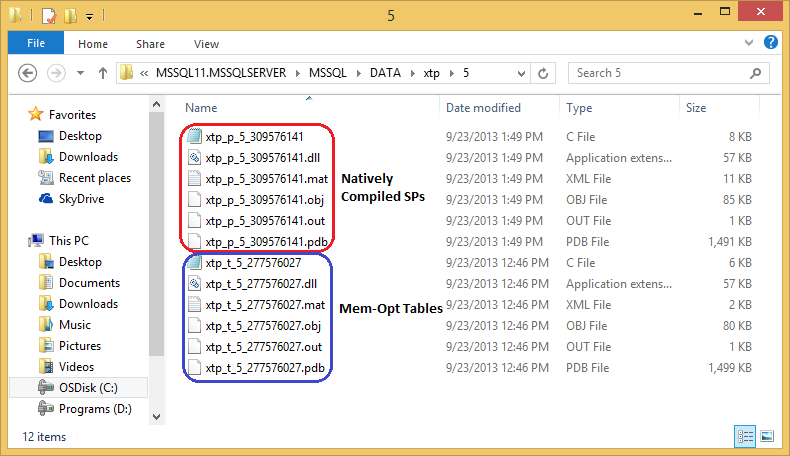
– It creates total 6 files for every Table & SP with following extensions: .c, .dll, .mat, .obj, .out and .pdb.
– Most important are the C Code and the DLL files with four (4) other supporting files for each Table the Stored Procedure and stores them at following path: “C:\Program Files\Microsoft SQL Server\MSSQL11.MSSQLSERVER\MSSQL\DATA\xtp\5\”.
– The “xtp” folder/directory here contains a sub-folder “5” which is nothing but the Database ID, check this:
SELECT DB_ID();

SELECT object_id, name, type
FROM sys.sysobjects
WHERE name IN ('Test_memoryOptimizedTable', 'Test_NativelyCompiledStoredProcedure');
– If you look closely the file are create with particular naming conventions and relate to the results of above query:
— For files xtp_t_5_277576027: xtp_t is for Table, 5 is the Database ID and 277576027 is the Object (table) ID.
— For files xtp_p_5_325576198: xtp_p is for Stored Procedure, 5 is the Database ID and 325576198 is the Object (Stored Procedure) ID.
–> Opening the xtp_t_5_277576027.c file looks like this:
#define __in
#define __out
#define __inout
#define __in_opt
#define __out_opt
#define __inout_opt
#define __in_ecount(x)
#define __out_ecount(x)
#define __deref_out_ecount(x)
#define __inout_ecount(x)
#define __in_bcount(x)
#define __out_bcount(x)
#define __deref_out_bcount(x)
#define __deref_out_range(x, y)
#define __success(x)
#define __inout_bcount(x)
#define __deref_opt_out
#define __deref_out
#define __checkReturn
#define __callback
#define __nullterminated

typedef unsigned char bool;
typedef unsigned short wchar_t;
typedef long HRESULT;

typedef unsigned __int64 ULONG_PTR;

#include "hkenggen.h"
#include "hkrtgen.h"
#include "hkgenlib.h"

#define ENABLE_INTSAFE_SIGNED_FUNCTIONS
#include "intsafe.h"

int _fltused = 0;

int memcmp(const void*, const void*, size_t);
void *memcpy(void*, const void*, size_t);
void *memset(void*, int, size_t);

#define offsetof(s,f)   ((size_t)&(((s*)0)->f))

struct hkt_277576027
{
	__int64 hkc_3;
	long hkc_1;
	unsigned short hkvdo[2];
};
struct hkis_27757602700002
{
	long hkc_1;
};
struct hkif_27757602700002
{
	long hkc_1;
};
unsigned short GetSerializeSize_277576027(
	struct HkRow const* hkRow)
{
	struct hkt_277576027 const* row = ((struct hkt_277576027 const*)hkRow);
	return ((row->hkvdo)[1]);
}
HRESULT Serialize_277576027(
	struct HkRow const* hkRow,
	unsigned char* buffer,
	unsigned short bufferSize,
	unsigned short* copySize)
{
	return (RowSerialize(hkRow, (GetSerializeSize_277576027(hkRow)), buffer, bufferSize, copySize));
}
HRESULT Deserialize_277576027(
	struct HkTransaction* tx,
	struct HkTable* table,
	unsigned char const* data,
	unsigned short datasize,
	struct HkRow** hkrow)
{
	return (RowDeserialize(tx, table, data, datasize, sizeof(struct hkt_277576027), (sizeof(struct hkt_277576027) + 200), hkrow));
}
unsigned short GetSerializeRecKeySize_277576027(
	struct HkRow const* hkRow)
{
	struct hkt_277576027 const* row = ((struct hkt_277576027 const*)hkRow);
	unsigned short size = sizeof(struct hkif_27757602700002);
	return size;
}
HRESULT SerializeRecKey_27757602700002(
	struct HkRow const* hkRow,
	unsigned char* hkKey,
	unsigned short bufferSize,
	unsigned short* keySize)
{
	struct hkt_277576027 const* row = ((struct hkt_277576027 const*)hkRow);
	struct hkif_27757602700002* key = ((struct hkif_27757602700002*)hkKey);
	(*keySize) = sizeof(struct hkif_27757602700002);
	if ((bufferSize < (*keySize)))
	{
		return -2013265920;
	}
	(key->hkc_1) = (row->hkc_1);
	return 0;
}
HRESULT DeserializeRecKey_277576027(
	unsigned char const* data,
	unsigned short dataSize,
	struct HkSearchKey* key,
	unsigned short bufferSize)
{
	struct hkif_27757602700002 const* source = ((struct hkif_27757602700002 const*)data);
	struct hkis_27757602700002* target = ((struct hkis_27757602700002*)key);
	unsigned long targetSize = sizeof(struct hkis_27757602700002);
	if ((targetSize > bufferSize))
	{
		return -2013265920;
	}
	(target->hkc_1) = (source->hkc_1);
	return 0;
}
__int64 CompareSKeyToRow_27757602700002(
	struct HkSearchKey const* hkArg0,
	struct HkRow const* hkArg1)
{
	struct hkis_27757602700002* arg0 = ((struct hkis_27757602700002*)hkArg0);
	struct hkt_277576027* arg1 = ((struct hkt_277576027*)hkArg1);
	__int64 ret;
	ret = (CompareKeys_int((arg0->hkc_1), (arg1->hkc_1)));
	return ret;
}
__int64 CompareRowToRow_27757602700002(
	struct HkRow const* hkArg0,
	struct HkRow const* hkArg1)
{
	struct hkt_277576027* arg0 = ((struct hkt_277576027*)hkArg0);
	struct hkt_277576027* arg1 = ((struct hkt_277576027*)hkArg1);
	__int64 ret;
	ret = (CompareKeys_int((arg0->hkc_1), (arg1->hkc_1)));
	return ret;
}
unsigned long ComputeSKeyHash_27757602700002(
	struct HkSearchKey const* hkArg)
{
	struct hkis_27757602700002* arg = ((struct hkis_27757602700002*)hkArg);
	unsigned long hashState = 0;
	unsigned long hashValue = 0;
	hashValue = (ComputeHash_int((arg->hkc_1), (&hashState)));
	return hashValue;
}
unsigned long ComputeRowHash_27757602700002(
	struct HkRow const* hkArg)
{
	struct hkt_277576027* arg = ((struct hkt_277576027*)hkArg);
	unsigned long hashState = 0;
	unsigned long hashValue = 0;
	hashValue = (ComputeHash_int((arg->hkc_1), (&hashState)));
	return hashValue;
}
struct HkOffsetInfo const KeyOffsetArray_27757602700002[] =
{

	{
		offsetof(struct hkis_27757602700002, hkc_1),
		0,
		0,
	},
};
struct HkKeyColsInfo const KeyColsInfoArray_277576027[] =
{

	{
		sizeof(struct hkis_27757602700002),
		KeyOffsetArray_27757602700002,
		sizeof(struct hkis_27757602700002),
		sizeof(struct hkis_27757602700002),
	},
};
struct HkOffsetInfo const OffsetArray_277576027[] =
{

	{
		offsetof(struct hkt_277576027, hkc_1),
		0,
		0,
	},

	{
		(offsetof(struct hkt_277576027, hkvdo) + 0),
		0,
		0,
	},

	{
		offsetof(struct hkt_277576027, hkc_3),
		0,
		0,
	},
};
struct HkColsInfo const ColsInfo_277576027 =
{
	sizeof(struct hkt_277576027),
	OffsetArray_277576027,
	KeyColsInfoArray_277576027,
};
struct HkHashIndexMD HashIndexMD_277576027[] =
{

	{
		2,
		1,
		1024,
		CompareSKeyToRow_27757602700002,
		CompareRowToRow_27757602700002,
		ComputeSKeyHash_27757602700002,
		ComputeRowHash_27757602700002,
	},
};
struct HkTableMD TableMD =
{
	sizeof(struct hkt_277576027),
	(sizeof(struct hkt_277576027) + 200),
	1,
	HashIndexMD_277576027,
	0,
	0,
	0,
	(&ColsInfo_277576027),
	277576027,
	0,
	GetSerializeSize_277576027,
	Serialize_277576027,
	Deserialize_277576027,
	GetSerializeRecKeySize_277576027,
	SerializeRecKey_27757602700002,
	DeserializeRecKey_277576027,
};
__declspec(dllexport)
struct HkTableBindings g_Bindings =
{
	277576027,
	(&TableMD),
};
I cannot understand a single bit here, but this recalls memories when I was studying C & C++ in college 🙂
–> Final Cleanup
DROP PROCEDURE dbo.Test_NativelyCompiledStoredProcedure
DROP TABLE dbo.Test_memoryOptimizedTable
Update: Know more about In-Memory tables:



Current Visitors

StatCounter …since April 2012


 Leisure blog: Creek & Trails
- NMDC Hyderabad Marathon – My first 42k FM, cramps, training and fuelling
- Singapore (Part 2) – 6 days itinerary, sightseeing & attractions
- Singapore (Part 1) – Tickets, Visa, Hotel, Forex Card/Cash, Metro/Bus cards
- I got full refund of my flight tickets during COVID lockdown (AirIndia via MakeMyTrip)
- YouTube – Your Google Ads account was cancelled due to no spend
- YouTube latest update on its YPP (YouTube Partner Program) which may affect your channel
- Starting your own blog !!!
- How to file ITR (Income Tax Return) online AY 2017-18 (for simple salaried)
- Scam – Become a kin/hier and earn a fortune – via LinkedIn and Email
- Places to visit in and around Vizag (aka Visakhapatnam)
 SQL with Manoj