Archive
SQL Trivia – What are Niladic functions in SQL Server?
Niladic functions are functions that do not accept any parameters, are specified without parentheses, and return only one result.
Following is the list of Niladic functions:
| Niladic function (SQL-92) | Value returned |
|---|---|
| CURRENT_TIMESTAMP | Current date and time. |
| CURRENT_USER | Name of user performing an insert. |
| SESSION_USER | Name of user performing an insert. |
| SYSTEM_USER | Name of user performing an insert. |
| USER | Name of user performing an insert. |
Execution of below query with these functions gives following results:
SELECT
	 CURRENT_TIMESTAMP AS 'CURRENT TIMESTAMP'
	,CURRENT_USER AS 'CURRENT USER'
	,SESSION_USER AS 'SESSION USER'
	,SYSTEM_USER AS 'SYSTEM USER'
	,USER AS 'USER'

Microsoft PSS – SQL 2016 Series: It just runs faster | Feb-March updates
Microsoft PSS Engineers have built a series on “It Just Runs Faster”!
“In the Sep 2014 the SQL Server CSS and Development teams performed a deep dive focused on scalability and performance when running on current and new hardware configurations. The SQL Server Development team tasked several individuals with scalability improvements and real world testing patterns. You can take advantage of this effort packaged in SQL Server 2016. – https://www.microsoft.com/en-us/server-cloud/products/sql-server-2016/”
SQL 2016 will run faster in many ways, without changing code.
The series kickoff is here:
https://blogs.msdn.microsoft.com/psssql/2016/02/23/sql-2016-it-just-runs-faster-announcement/
The first article in this series came out the end of February:
SQL 2016 – It Just Runs Faster: DBCC Scales 7x Better
https://blogs.msdn.microsoft.com/psssql/2016/02/25/sql-2016-it-just-runs-faster-dbcc-scales-7x-better/
The announcements so far in March are:
SQL 2016 – It Just Runs Faster: DBCC Extended Checks
https://blogs.msdn.microsoft.com/psssql/2016/03/01/sql-2016-it-just-runs-faster-dbcc-extended-checks/
SQL 2016 – It Just Runs Faster: Native Spatial Implementation(s)
https://blogs.msdn.microsoft.com/psssql/2016/03/03/sql-2016-it-just-runs-faster-native-spatial-implementations/
SQL Server Parallel Query Placement Decision Logic
https://blogs.msdn.microsoft.com/psssql/2016/03/04/sql-server-parallel-query-placement-decision-logic/
SQL 2016 – It Just Runs Faster: TVPs with Spatial Column(s)
https://blogs.msdn.microsoft.com/psssql/2016/03/08/sql-2016-it-just-runs-faster-tvps-with-spatial-columns/
SQL 2016 – It Just Runs Faster: Spatial Index Builds Faster
https://blogs.msdn.microsoft.com/psssql/2016/03/10/sql-2016-it-just-runs-faster-spatial-index-builds-faster/
SQL 2016 – It Just Runs Faster: -T1117 and -T1118 changes for TEMPDB and user databases
https://blogs.msdn.microsoft.com/psssql/2016/03/15/sql-2016-it-just-runs-faster-t1117-and-t1118-changes-for-tempdb-and-user-databases/
SQL 2016 – It Just Runs Faster: Automatic TEMPDB Configuration
https://blogs.msdn.microsoft.com/psssql/2016/03/17/sql-2016-it-just-runs-faster-automatic-tempdb-configuration/
SQL 2016 – It Just Runs Faster: LDF Stamped
https://blogs.msdn.microsoft.com/psssql/2016/03/22/sql-2016-it-just-runs-faster-ldf-stamped/
SQL 2016 – It Just Runs Faster: Instant File Initialization
https://blogs.msdn.microsoft.com/psssql/2016/03/25/sql-2016-it-just-runs-faster-instant-file-initialization/
SQL 2016 – It Just Runs Faster: Automatic Soft NUMA
https://blogs.msdn.microsoft.com/psssql/2016/03/30/sql-2016-it-just-runs-faster-automatic-soft-numa/
Check my blog posts on most of the new features released in SQL Server 2016 here
Custom Query to check Frequency, Interval and Time of multiple Job’s in SQL Server
In my [previous post] I discussed about the system SPs that we can use to get details of a SQL Job, like its Name, ID, Description, Schedule, etc. But what if you need to check these details of various SQL Jobs?
Here in this post we will see how we check the Job Schedule of various SQL Jobs, like:
1. Enable/Disable
2. Frequency (Once, Daily, Weekly, Monthly, etc.)
3. Interval (Specific time, Seconds, Minutes, Hours, etc.)
4. Start Date and Time
5. Description
… by using some system views, like:
– sysJobs
– sysJobsShedules
– sysSchedules
select
	 'Job ID' = j.job_id
	,'Job Name' = j.name
	,'Job Enabled' = case j.enabled
			when 1 then 'Yes'
			else 'No'
		end
	,'Frequency' = case s.freq_type
		when 1 then 'One time only'
		when 4 then 'Daily'
		when 8 then 'Weekly'
		when 16 then 'Monthly'
		when 32 then 'Monthly, relative to freq_interval'
		when 64 then 'Runs when the SQL Server Agent service starts'
		when 128 then 'Runs when the computer is idle'
	end
	,'Interval' = case s.freq_subday_type
		when 1 then 'At specified time'
		when 2 then CAST(freq_subday_interval AS VARCHAR(3)) + ' Seconds'
		when 4 then CAST(freq_subday_interval AS VARCHAR(3)) + ' Minutes'
		when 8 then CAST(freq_subday_interval AS VARCHAR(3)) + ' Hours'
	end
	,'Start_Date' = substring(convert(varchar(15),active_start_date),1,4)
		+ '/' + substring(convert(varchar(15),active_start_date),5,2) + '/'
		+ substring(convert(varchar(15),active_start_date),7,2)
		+ ' ' +
		case len(active_start_time)
			when 1 then cast('00:00:0' + right(active_start_time,2) as char(8))
			when 2 then cast('00:00:' + right(active_start_time,2) as char(8))
			when 3 then cast('00:0'
					+ left(right(active_start_time,3),1)
					+':' + right(active_start_time,2) as char (8))
			when 4 then cast('00:'
					+ left(right(active_start_time,4),2)
					+':' + right(active_start_time,2) as char (8))
			when 5 then cast('0'
					+ left(right(active_start_time,5),1)
					+':' + Left(right(active_start_time,4),2)
					+':' + right(active_start_time,2) as char (8))
			when 6 then cast(Left(right(active_start_time,6),2)
					+':' + Left(right(active_start_time,4),2)
					+':' + right(active_start_time,2) as char (8))
		end
	,'Schedule Enabled' = case s.enabled
            when 1 then 'Yes'
            else 'No'
        end
    ,'Schedule Desc' = s.name
from msdb.dbo.sysjobs j
inner join msdb.dbo.sysjobschedules js
on j.job_id = js.job_id
inner join msdb.dbo.sysschedules s
on s.schedule_id = js.schedule_id
order by j.name
GO
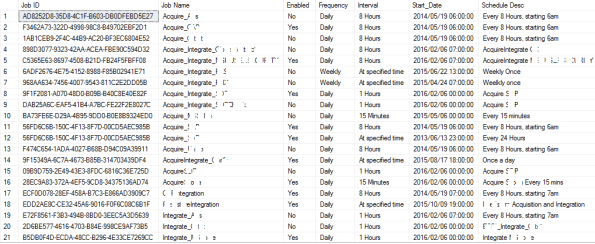
I’ve created the above query by collating references form forums and MSDN BoL, you can tweak and modify this query as well as per your requirements.
Using system SPs to get details of SQL Jobs, Steps, Commands, Schedule, Last run details, etc
Sometimes it get difficult or time-taking to get each and every SQL Job details, its schedule and other information. Also checking all these information in SSMS is time taking specially when your machine is running a client, and the server is located in some remote place. On the other side if you get some handy system Queries you can fire them in SSMS and get the desired results immediately, without browsing too much on heavy GUI tools.
Here are some of the System Stored Procedure queries that can be used to check the SQL Job details, like:
1. Job Details:
– Job ID/Name/Description
– Category
– Date Created/Modified
– Last/Next run Date/Time
– Current execution status
2.Job Steps
– Step ID/Names
– SQL Commands in each step
– On Success/Fail action
– Last run Duration/Retries/Date/Time
3. Job Schedule:
– Schedule ID/Name/Description
– Enable/Disable Status
– Job Frequency/Interval
– Job Start Date/Time
– Next run Date/Time
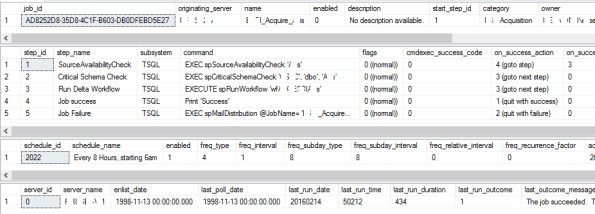
–> sp_help_job: system SP gives you all these information in 4 different result sets as shown in the image below. You can pass Job-Name or Job-ID as parameter to the system SP.
exec msdb.dbo.sp_help_job @job_name = 'Acquire_Source_Data'
-- OR --
exec msdb.dbo.sp_help_job @job_id = 'ad8252d8-35d8-4c1f-b603-db0dfebd5e27'
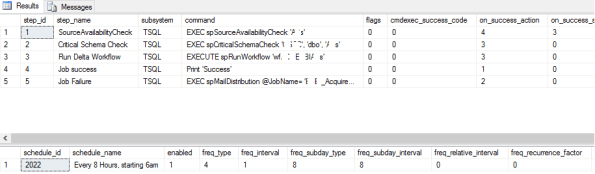
–> sp_help_jobstep & sp_help_jobschedule: these 2 SPs also gives similar information provided by above SP (sp_help-job), but with single result-set. So you can execute them independently and use them in your logic.
exec msdb.dbo.sp_help_jobstep @job_id = 'ad8252d8-35d8-4c1f-b603-db0dfebd5e27'

exec msdb.dbo.sp_help_jobschedule @job_id = 'ad8252d8-35d8-4c1f-b603-db0dfebd5e27'
--
View Dependencies of a Table from SSMS and T-SQL script used internally by SSMS
Here we will see how to check the Table level dependencies, means what all Database Objects a Table is related to, like Views, Stored Procedures (SPs), Functions (UDFs), Triggers, etc.
Go to Object Explorer, and expand the Databases -> Tables and Right click on the Table that you want to see dependencies.
Select View Dependencies, you will get a popup listing all objects that depends upon this table.
–>1. The below image shows the Objects that depend on Customer table:

–>2. Once you select the second radio-button it shows the Objects on which Customer table depends:

–> And here is a very lengthy (~900 lines) T-SQL Code that I generated from SSMS & SQL Profiler to check the same Dependencies of a Table in SQL Server 2014. You can also create a Stored Procedure and apply the Table & Schema as parameters.
You can just replace the Table & Schema in the first 2 lines and execute the code to check table dependencies:
DECLARE @Table_name  NVARCHAR(1000) = N'Customer' -- replace your table here
DECLARE @Schema_name NVARCHAR(1000) = N'Sales' -- replace the schema here

CREATE TABLE #tempdep (objid int NOT NULL, objname sysname NOT NULL, objschema sysname NULL, objdb sysname NOT NULL, objtype smallint NOT NULL)

BEGIN TRANSACTION

exec sp_executesql N'INSERT INTO #tempdep

SELECT
tbl.object_id AS [ID],
tbl.name AS [Name],
SCHEMA_NAME(tbl.schema_id) AS [Schema],
db_name(),
3
FROM
sys.tables AS tbl
WHERE
(tbl.name=@_msparam_0 and SCHEMA_NAME(tbl.schema_id)=@_msparam_1)',N'@_msparam_0 nvarchar(4000),@_msparam_1 nvarchar(4000)',@_msparam_0=@Table_name,@_msparam_1=@Schema_name

COMMIT TRANSACTION

declare @find_referencing_objects int
set @find_referencing_objects = 1 -- Objects that depend on Customer table
--set @find_referencing_objects = 0 -- Objects on which Customer table depends

-- parameters:
-- 1. create table #tempdep (objid int NOT NULL, objtype smallint NOT NULL)
--    contains source objects
-- 2. @find_referencing_objects defines ordering
--    1 order for drop
--    0 order for script

declare @must_set_nocount_off bit
set @must_set_nocount_off = 0

IF @@OPTIONS & 512 = 0
   set @must_set_nocount_off = 1
set nocount on

declare @u int
declare @udf int
declare @v int
declare @sp int
declare @def int
declare @rule int
declare @tr int
declare @uda int
declare @uddt int
declare @xml int
declare @udt int
declare @assm int
declare @part_sch int
declare @part_func int
declare @synonym int
declare @sequence int
declare @udtt int
declare @ddltr int
declare @unknown int
declare @pg int

set @u = 3
set @udf = 0
set @v = 2
set @sp = 4
set @def = 6
set @rule = 7
set @tr = 8
set @uda = 11
set @synonym = 12
set @sequence = 13
--above 100 -> not in sys.objects
set @uddt = 101
set @xml = 102
set @udt = 103
set @assm = 1000
set @part_sch = 201
set @part_func = 202
set @udtt = 104
set @ddltr = 203
set @unknown = 1001
set @pg = 204

-- variables for referenced type obtained from sys.sql_expression_dependencies
declare @obj int
set @obj = 20
declare @type int
set @type = 21
-- variables for xml and part_func are already there

create table #t1
(
	object_id int NULL,
	object_name sysname collate database_default NULL,
	object_schema sysname collate database_default NULL,
	object_db sysname NULL,
	object_svr sysname NULL,
	object_type smallint NOT NULL,
	relative_id int NOT NULL,
	relative_name sysname collate database_default NOT NULL,
	relative_schema sysname collate database_default NULL,
	relative_db sysname NULL,
	relative_svr sysname NULL,
	relative_type smallint NOT NULL,
	schema_bound bit NOT NULL,
	rank smallint NULL,
	degree int NULL
)

-- we need to create another temporary table to store the dependencies from sys.sql_expression_dependencies till the updated values are inserted finally into #t1
create table #t2
(
	object_id int NULL,
	object_name sysname collate database_default NULL,
	object_schema sysname collate database_default NULL,
	object_db sysname NULL,
	object_svr sysname NULL,
	object_type smallint NOT NULL,
	relative_id int NOT NULL,
	relative_name sysname collate database_default NOT NULL,
	relative_schema sysname collate database_default NULL,
	relative_db sysname NULL,
	relative_svr sysname NULL,
	relative_type smallint NOT NULL,
	schema_bound bit NOT NULL,
	rank smallint NULL
)

-- This index will ensure that we have unique parent-child relationship
create unique clustered index i1 on #t1(object_name, object_schema, object_db, object_svr, object_type, relative_name, relative_schema, relative_type) with IGNORE_DUP_KEY

declare @iter_no int
set @iter_no = 1

declare @rows int
set @rows = 1

insert #t1 (object_id, object_name, object_schema, object_db, object_type, relative_id, relative_name, relative_schema, relative_db, relative_type, schema_bound, rank)
   select l.objid, l.objname, l.objschema, l.objdb, l.objtype, l.objid, l.objname, l.objschema, l.objdb, l.objtype, 1, @iter_no from #tempdep l

-- change the object_id of table types to their user_defined_id
update #t1 set object_id = tt.user_type_id, relative_id = tt.user_type_id
from sys.table_types as tt where tt.type_table_object_id = #t1.object_id and object_type = @udtt

while @rows > 0
begin
	set @rows = 0
	if (1 = @find_referencing_objects)
	begin
		-- HARD DEPENDENCIES
		-- these dependencies have to be in the same database only

		-- tables that reference uddts or udts
		insert #t1 (object_id, object_name, object_schema, object_db, object_type, relative_id, relative_name, relative_schema, relative_db, relative_type, schema_bound, rank)
			select tbl.object_id, tbl.name, SCHEMA_NAME(tbl.schema_id), t.object_db, @u, t.object_id, t.object_name, t.object_schema, t.object_db, t.object_type, 1, @iter_no + 1
			from #t1 as t
			join sys.columns as c on c.user_type_id = t.object_id
			join sys.tables as tbl on tbl.object_id = c.object_id
			where @iter_no = t.rank and (t.object_type = @uddt OR t.object_type = @udt) and (t.object_svr IS null and t.object_db = db_name())
		set @rows = @rows + @@rowcount

		-- udtts that reference uddts or udts
		insert #t1 (object_id, object_name, object_schema, object_db, object_type, relative_id, relative_name, relative_schema, relative_db, relative_type, schema_bound, rank)
			select tt.user_type_id, tt.name, SCHEMA_NAME(tt.schema_id), t.object_db, @udtt, t.object_id, t.object_name, t.object_schema, t.object_db, t.object_type, 1, @iter_no + 1
			from #t1 as t
			join sys.columns as c on c.user_type_id = t.object_id
			join sys.table_types as tt on tt.type_table_object_id = c.object_id
			where @iter_no = t.rank and (t.object_type = @uddt OR t.object_type = @udt) and (t.object_svr IS null and t.object_db = db_name())
		set @rows = @rows + @@rowcount

		-- tables/views that reference triggers
		insert #t1 (object_id, object_name, object_schema, object_db, object_type, relative_id, relative_name, relative_schema, relative_db, relative_type, schema_bound, rank)
			select o.object_id, o.name, SCHEMA_NAME(o.schema_id), t.object_db, @tr, t.object_id, t.object_name, t.object_schema, t.object_db, t.object_type, 1, @iter_no + 1
			from #t1 as t
			join sys.objects as o on o.parent_object_id = t.object_id and o.type = 'TR'
			where @iter_no = t.rank and (t.object_type = @u OR  t.object_type = @v) and (t.object_svr IS null and t.object_db = db_name())
		set @rows = @rows + @@rowcount

		-- tables that reference defaults (only default objects)
		insert #t1 (object_id, object_name, object_schema, object_db, object_type, relative_id, relative_name, relative_schema, relative_db, relative_type, schema_bound, rank)
			select o.object_id, o.name, SCHEMA_NAME(o.schema_id), t.object_db, @u, t.object_id, t.object_name, t.object_schema, t.object_db, t.object_type, 1, @iter_no + 1
			from #t1 as t
			join sys.columns as clmns on clmns.default_object_id = t.object_id
			join sys.objects as o on o.object_id = clmns.object_id and 0 = isnull(o.parent_object_id, 0)
			where @iter_no = t.rank and t.object_type = @def and (t.object_svr IS null and t.object_db = db_name())
		set @rows = @rows + @@rowcount

		-- types that reference defaults (only default objects)
		insert #t1 (object_id, object_name, object_schema, object_db, object_type, relative_id, relative_name, relative_schema, relative_db, relative_type, schema_bound, rank)
			select tp.user_type_id, tp.name, SCHEMA_NAME(tp.schema_id), t.object_db, @uddt, t.object_id, t.object_name, t.object_schema, t.object_db, t.object_type, 1, @iter_no + 1
			from #t1 as t
			join sys.types as tp on tp.default_object_id = t.object_id
			join sys.objects as o on o.object_id = t.object_id and 0 = isnull(o.parent_object_id, 0)
			where @iter_no = t.rank and t.object_type = @def and (t.object_svr IS null and t.object_db = db_name())
		set @rows = @rows + @@rowcount

		-- tables that reference rules
		insert #t1 (object_id, object_name, object_schema, object_db, object_type, relative_id, relative_name, relative_schema, relative_db, relative_type, schema_bound, rank)
			select tbl.object_id, tbl.name, SCHEMA_NAME(tbl.schema_id), t.object_db, @u, t.object_id, t.object_name, t.object_schema, t.object_db, t.object_type, 1, @iter_no + 1
			from #t1 as t
			join sys.columns as clmns on clmns.rule_object_id = t.object_id
			join sys.tables as tbl on tbl.object_id = clmns.object_id
			where @iter_no = t.rank and t.relative_type = @rule and (t.object_svr IS null and t.object_db = db_name())
		set @rows = @rows + @@rowcount

		-- types that reference rules
		insert #t1 (object_id, object_name, object_schema, object_db, object_type, relative_id, relative_name, relative_schema, relative_db, relative_type, schema_bound, rank)
			select tp.user_type_id, tp.name, SCHEMA_NAME(tp.schema_id), t.object_db, @uddt, t.object_id, t.object_name, t.object_schema, t.object_db, t.object_type, 1, @iter_no + 1
			from #t1 as t
			join sys.types as tp on tp.rule_object_id = t.object_id
			where @iter_no = t.rank and t.object_type = @rule and (t.object_svr IS null and t.object_db = db_name())
		set @rows = @rows + @@rowcount

		-- tables that reference XmlSchemaCollections
		insert #t1 (object_id, object_name, object_schema, object_db, object_type, relative_id, relative_name, relative_schema, relative_db, relative_type, schema_bound, rank)
			select tbl.object_id, tbl.name, SCHEMA_NAME(tbl.schema_id), t.object_db, @u, t.object_id, t.object_name, t.object_schema, t.object_db, t.object_type, 1, @iter_no + 1
			from #t1 as t
			join sys.columns as c on c.xml_collection_id = t.object_id
			join sys.tables as tbl on tbl.object_id = c.object_id -- eliminate views
			where @iter_no = t.rank and t.object_type = @xml and (t.object_svr IS null and t.object_db = db_name())
		set @rows = @rows + @@rowcount

		-- table types that reference XmlSchemaCollections
		insert #t1 (object_id, object_name, object_schema, object_db, object_type, relative_id, relative_name, relative_schema, relative_db, relative_type, schema_bound, rank)
			select tt.user_type_id, tt.name, SCHEMA_NAME(tt.schema_id), t.object_db, @udtt, t.object_id, t.object_name, t.object_schema, t.object_db, t.object_type, 1, @iter_no + 1
			from #t1 as t
			join sys.columns as c on c.xml_collection_id = t.object_id
			join sys.table_types as tt on tt.type_table_object_id = c.object_id
			where @iter_no = t.rank and t.object_type = @xml and (t.object_svr IS null and t.object_db = db_name())
		set @rows = @rows + @@rowcount

		-- procedures that reference XmlSchemaCollections
		insert #t1 (object_id, object_name, object_schema, object_db, object_type, relative_id, relative_name, relative_schema, relative_db, relative_type, schema_bound, rank)
			select o.object_id, o.name, SCHEMA_NAME(o.schema_id), t.object_db, (case when o.type in ( 'P', 'RF', 'PC') then @sp else @udf end), t.object_id, t.object_name, t.object_schema, t.object_db, t.object_type, 1, @iter_no + 1
			from #t1 as t
			join sys.parameters as c on c.xml_collection_id = t.object_id
			join sys.objects as o on o.object_id = c.object_id
			where @iter_no = t.rank and t.object_type = @xml and (t.object_svr IS null and t.object_db = db_name())
		set @rows = @rows + @@rowcount
		-- udf, sp, uda, trigger all that reference assembly
		insert #t1 (object_id, object_name, object_schema, object_db, object_type, relative_id, relative_name, relative_schema, relative_db, relative_type, schema_bound, rank)
			select o.object_id, o.name, SCHEMA_NAME(o.schema_id), t.object_db, (case o.type when 'AF' then @uda when 'PC' then @sp when 'FS' then @udf when 'FT' then @udf when 'TA' then @tr else @udf end), t.object_id, t.object_name, t.object_schema, t.object_db, t.object_type, 1, @iter_no + 1
			from #t1 as t
			join sys.assembly_modules as am on ((am.assembly_id = t.object_id) and (am.assembly_id >= 65536))
			join sys.objects as o on am.object_id = o.object_id
			where @iter_no = t.rank and t.object_type = @assm and (t.object_svr IS null and t.object_db = db_name())
		set @rows = @rows + @@rowcount
		-- udt that reference assembly
		insert #t1 (object_id, object_name, object_schema, object_db, object_type, relative_id, relative_name, relative_schema, relative_db, relative_type, schema_bound, rank)
			select at.user_type_id, at.name, SCHEMA_NAME(at.schema_id), t.object_db, @udt, t.object_id, t.object_name, t.object_schema, t.object_db, t.object_type, 1, @iter_no + 1
			from #t1 as t
			join sys.assembly_types as at on ((at.assembly_id = t.object_id) and (at.is_user_defined = 1))
			where @iter_no = t.rank and t.object_type = @assm and (t.object_svr IS null and t.object_db = db_name())
		set @rows = @rows + @@rowcount

		-- assembly that reference assembly
		insert #t1 (object_id, object_name, object_db, object_type, relative_id, relative_name, relative_schema, relative_db, relative_type, schema_bound, rank)
			select asm.assembly_id, asm.name, t.object_db, @assm, t.object_id, t.object_name, t.object_schema, t.object_db, t.object_type, 1, @iter_no + 1
			from #t1 as t
			join sys.assembly_references as ar on ((ar.referenced_assembly_id = t.object_id) and (ar.referenced_assembly_id >= 65536))
			join sys.assemblies as asm on asm.assembly_id = ar.assembly_id
			where @iter_no = t.rank and t.object_type = @assm and (t.object_svr IS null and t.object_db = db_name())
		set @rows = @rows + @@rowcount

		-- table references table
		insert #t1 (object_id, object_name, object_schema, object_db, object_type, relative_id, relative_name, relative_schema, relative_db, relative_type, schema_bound, rank)
			select tbl.object_id, tbl.name, SCHEMA_NAME(tbl.schema_id), t.object_db, @u, t.object_id, t.object_name, t.object_schema, t.object_db, t.object_type, 1, @iter_no + 1
			from #t1 as t
			join sys.foreign_keys as fk on fk.referenced_object_id = t.object_id
			join sys.tables as tbl on tbl.object_id = fk.parent_object_id
			where @iter_no = t.rank and t.object_type = @u and (t.object_svr IS null and t.object_db = db_name())
		set @rows = @rows + @@rowcount

		-- uda references types
		insert #t1 (object_id, object_name, object_schema, object_db, object_type, relative_id, relative_name, relative_schema, relative_db, relative_type, schema_bound, rank)
			select o.object_id, o.name, SCHEMA_NAME(o.schema_id), t.object_db, @uda, t.object_id, t.object_name, t.object_schema, t.object_db, t.object_type, 1, @iter_no + 1
			from #t1 as t
			join sys.parameters as p on p.user_type_id = t.object_id
			join sys.objects as o on o.object_id = p.object_id and o.type = 'AF'
			where @iter_no = t.rank and t.object_type in (@udt, @uddt, @udtt) and (t.object_svr IS null and t.object_db = db_name())

		-- table,view references partition scheme
		insert #t1 (object_id, object_name, object_schema, object_db, object_type, relative_id, relative_name, relative_schema, relative_db, relative_type, schema_bound, rank)
			select o.object_id, o.name, SCHEMA_NAME(o.schema_id), t.object_db, (case o.type when 'V' then @v else @u end), t.object_id, t.object_name, t.object_schema, t.object_db, t.object_type, 1, @iter_no + 1
			from #t1 as t
			join sys.indexes as idx on idx.data_space_id = t.object_id
			join sys.objects as o on o.object_id = idx.object_id
			where @iter_no = t.rank and t.object_type = @part_sch and (t.object_svr IS null and t.object_db = db_name())
		set @rows = @rows + @@rowcount

		-- partition scheme references partition function
		insert #t1 (object_id, object_name, object_db, object_type, relative_id, relative_name, relative_schema, relative_db, relative_type, schema_bound, rank)
			select ps.data_space_id, ps.name, t.object_db, @part_sch, t.object_id, t.object_name, t.object_schema, t.object_db, t.object_type, 1, @iter_no + 1
			from #t1 as t
			join sys.partition_schemes as ps on ps.function_id = t.object_id
			where @iter_no = t.rank and t.object_type = @part_func and (t.object_svr IS null and t.object_db = db_name())
		set @rows = @rows + @@rowcount

		-- plan guide references sp, udf, triggers
		insert #t1 (object_id, object_name, object_db, object_type, relative_id, relative_name, relative_schema, relative_db, relative_type, schema_bound, rank)
			select pg.plan_guide_id, pg.name, t.object_db, @pg, t.object_id, t.object_name, t.object_schema, t.object_db, t.object_type, 1, @iter_no + 1
			from #t1 as t
			join sys.plan_guides as pg on pg.scope_object_id = t.object_id
			where @iter_no = t.rank and t.object_type in (@sp, @udf, @tr) and (t.object_svr IS null and t.object_db = db_name())
		set @rows = @rows + @@rowcount

		-- synonym refrences object
		insert #t1 (object_id, object_name, object_schema, object_db, object_type, relative_id, relative_name, relative_schema, relative_db, relative_type, schema_bound, rank)
			select s.object_id, s.name, SCHEMA_NAME(s.schema_id), t.object_db, @synonym, t.object_id, t.object_name, t.object_schema, t.object_db, t.object_type, 0, @iter_no + 1
			from #t1 as t
			join sys.synonyms as s on object_id(s.base_object_name) = t.object_id
			where @iter_no = t.rank and (t.object_svr IS null and t.object_db = db_name())
		set @rows = @rows + @@rowcount

		--  sequences that reference uddts
		insert #t1 (object_id, object_name, object_schema, object_db, object_type, relative_id, relative_name, relative_schema, relative_db, relative_type, schema_bound, rank)
			select s.object_id, s.name, SCHEMA_NAME(s.schema_id), t.object_db, @sequence, t.object_id, t.object_name, t.object_schema, t.object_db, t.object_type, 0, @iter_no + 1
			from #t1 as t
			join sys.sequences as s on s.user_type_id = t.object_id
			where @iter_no = t.rank and (t.object_type = @uddt) and (t.object_svr IS null and t.object_db = db_name())
		set @rows = @rows + @@rowcount


		-- SOFT DEPENDENCIES
		DECLARE name_cursor CURSOR
		FOR
			SELECT DISTINCT t.object_id, t.object_name, t.object_schema, t.object_type
			FROM #t1 as t
			WHERE @iter_no = t.rank and (t.object_svr IS null and t.object_db = db_name()) and t.object_type NOT IN (@part_sch, @assm, @tr, @ddltr)
		OPEN name_cursor
		DECLARE @objid int
		DECLARE @objname sysname
		DECLARE @objschema sysname
		DECLARE @objtype smallint
		DECLARE @fullname sysname
		DECLARE @objecttype sysname
		FETCH NEXT FROM name_cursor INTO @objid, @objname, @objschema, @objtype
		WHILE (@@FETCH_STATUS <> -1)
		BEGIN
			SET @fullname = case when @objschema IS NULL then quotename(@objname)
							else quotename(@objschema) + '.' + quotename(@objname) end
			SET @objecttype = case when @objtype in (@uddt, @udt, @udtt) then 'TYPE'
								when @objtype = @xml then 'XML_SCHEMA_COLLECTION'
								when @objtype = @part_func then 'PARTITION_FUNCTION'
								else 'OBJECT' end
			insert #t2 (object_type, object_id, object_name, object_schema, object_db, object_svr, relative_id, relative_name, relative_schema, relative_db, relative_type, schema_bound, rank)
				select
					case dep.referencing_class when 1 then (select
						case when obj.type = 'U' then @u
						when obj.type = 'V' then @v
						when obj.type = 'TR' then @tr
						when obj.type in ('P', 'RF', 'PC') then @sp
						when obj.type in ('AF') then @uda
						when obj.type in ('TF', 'FN', 'IF', 'FS', 'FT') then @udf
						when obj.type = 'D' then @def
						when obj.type = 'SN' then @synonym
						when obj.type = 'SO' then @sequence
						else @obj
						end
					from sys.objects as obj where obj.object_id = dep.referencing_id)
				when 6 then (select
						case when (tp.is_assembly_type = 1) then @udt
						when (tp.is_table_type = 1) then @udtt
						else @uddt
						end
					from sys.types as tp where tp.user_type_id = dep.referencing_id)
				when 7 then @u
				when 9 then @u
				when 10 then @xml
				when 12 then @ddltr
				when 21 then @part_func
				end,
			dep.referencing_id,
			dep.referencing_entity_name,
			dep.referencing_schema_name,
			db_name(), null,
			@objid, @objname,
			@objschema, db_name(), @objtype,
			0, @iter_no + 1
			from sys.dm_sql_referencing_entities(@fullname, @objecttype) dep

			FETCH NEXT FROM name_cursor INTO @objid, @objname, @objschema, @objtype
		END
		CLOSE name_cursor
		DEALLOCATE name_cursor

		update #t2 set object_id = obj.object_id, object_name = obj.name, object_schema = schema_name(obj.schema_id), object_type = case when obj.type = 'U' then @u when obj.type = 'V' then @v end
		from sys.objects as o
		join sys.objects as obj on obj.object_id = o.parent_object_id
		where o.object_id = #t2.object_id and (#t2.object_type = @obj OR o.parent_object_id != 0) and #t2.rank = @iter_no + 1

		insert #t1 (object_id, object_name, object_schema, object_db, object_svr, object_type, relative_id, relative_name, relative_schema, relative_db, relative_svr, relative_type, schema_bound, rank)
			select object_id, object_name, object_schema, object_db, object_svr, object_type, relative_id, relative_name, relative_schema, relative_db, relative_svr, relative_type, schema_bound, rank
			from #t2 where @iter_no + 1 = rank and #t2.object_id != #t2.relative_id
		set @rows = @rows + @@rowcount

	end
	else
	begin
		-- SOFT DEPENDENCIES
		-- insert all values from sys.sql_expression_dependencies for the corresponding object
		-- first insert them in #t2, update them and then finally insert them in #t1
		insert #t2 (object_type, object_name, object_schema, object_db, object_svr, relative_id, relative_name, relative_schema, relative_db, relative_type, schema_bound, rank)
			select
				case dep.referenced_class when 1 then @obj
				when 6 then @type
				when 7 then @u
				when 9 then @u
				when 10 then @xml
				when 21 then @part_func
				end,
			dep.referenced_entity_name,
			dep.referenced_schema_name,
			dep.referenced_database_name,
			dep.referenced_server_name,
			t.object_id, t.object_name, t.object_schema, t.object_db, t.object_type,
			dep.is_schema_bound_reference, @iter_no + 1
			from #t1 as t
			join sys.sql_expression_dependencies as dep on dep.referencing_id = t.object_id
			where @iter_no = t.rank and t.object_svr IS NULL and t.object_db = db_name()

		-- insert all the dependency values in case of a table that references a check
		insert #t2 (object_type, object_name, object_schema, object_db, object_svr, relative_id, relative_name, relative_schema, relative_db, relative_type, schema_bound, rank)
			select
				case dep.referenced_class when 1 then @obj
				when 6 then @type
				when 7 then @u
				when 9 then @u
				when 10 then @xml
				when 21 then @part_func
				end,
			dep.referenced_entity_name,
			dep.referenced_schema_name,
			dep.referenced_database_name,
			dep.referenced_server_name,
			t.object_id, t.object_name, t.object_schema, t.object_db, t.object_type,
			dep.is_schema_bound_reference, @iter_no + 1
			from #t1 as t
			join sys.sql_expression_dependencies as d on d.referenced_id = t.object_id
			join sys.objects as o on o.object_id = d.referencing_id and o.type = 'C'
			join sys.sql_expression_dependencies as dep on dep.referencing_id = d.referencing_id and dep.referenced_id != t.object_id
			where @iter_no = t.rank and t.object_svr IS NULL and t.object_db = db_name() and t.object_type = @u

		-- insert all the dependency values in case of an object that belongs to another object whose dependencies are being found
		insert #t2 (object_type, object_name, object_schema, object_db, object_svr, relative_id, relative_name, relative_schema, relative_db, relative_type, schema_bound, rank)
			select
				case dep.referenced_class when 1 then @obj
				when 6 then @type
				when 7 then @u
				when 9 then @u
				when 10 then @xml
				when 21 then @part_func
				end,
			dep.referenced_entity_name,
			dep.referenced_schema_name,
			dep.referenced_database_name,
			dep.referenced_server_name,
			t.object_id, t.object_name, t.object_schema, t.object_db, t.object_type,
			dep.is_schema_bound_reference, @iter_no + 1
			from #t1 as t
			join sys.objects as o on o.parent_object_id = t.object_id
			join sys.sql_expression_dependencies as dep on dep.referencing_id = o.object_id
			where @iter_no = t.rank and t.object_svr IS NULL and t.object_db = db_name()

		-- queries for objects with object_id null and object_svr null - resolve them
		-- we will build the query to resolve the objects
		-- increase @rows as we bind the objects

		DECLARE db_cursor CURSOR
		FOR
			select distinct ISNULL(object_db, db_name()) from #t2 as t
			where t.rank = (@iter_no+1) and t.object_id IS NULL and t.object_svr IS NULL
		OPEN db_cursor
	    DECLARE @dbname sysname
		FETCH NEXT FROM db_cursor INTO @dbname
		WHILE (@@FETCH_STATUS <> -1)
		BEGIN
			IF (db_id(@dbname) IS NULL)
			BEGIN
				FETCH NEXT FROM db_cursor INTO @dbname
				CONTINUE
			END
			DECLARE @query nvarchar(MAX)
			-- when schema is not null
			-- @obj
			SET @query = 'update #t2 set object_db = N' + quotename(@dbname, '''') + ', object_id = obj.object_id, object_type =
							case when obj.type = ''U'' then ' + CAST(@u AS nvarchar(8)) +
							' when obj.type = ''V'' then ' + CAST(@v AS nvarchar(8)) +
							' when obj.type = ''TR'' then ' + CAST(@tr AS nvarchar(8)) +
							' when obj.type in ( ''P'', ''RF'', ''PC'' ) then ' + CAST(@sp AS nvarchar(8)) +
							' when obj.type in ( ''AF'' ) then ' + CAST(@uda AS nvarchar(8)) +
							' when obj.type in ( ''TF'', ''FN'', ''IF'', ''FS'', ''FT'' ) then ' + CAST(@udf AS nvarchar(8)) +
							' when obj.type = ''D'' then ' + CAST(@def AS nvarchar(8)) +
							' when obj.type = ''SN'' then ' + CAST(@synonym AS nvarchar(8)) +
							' when obj.type = ''SO'' then ' + CAST(@sequence AS nvarchar(8)) +
							' else ' + CAST(@unknown AS nvarchar(8)) +
							' end
				from ' + quotename(@dbname) + '.sys.objects as obj
				join ' + quotename(@dbname) + '.sys.schemas as sch on sch.schema_id = obj.schema_id
				where obj.name = #t2.object_name collate database_default
				and sch.name = #t2.object_schema collate database_default
				and #t2.object_type = ' + CAST(@obj AS nvarchar(8)) + ' and #t2.object_schema IS NOT NULL
				and (#t2.object_db IS NULL or #t2.object_db = ''' + @dbname + ''')
				and #t2.rank = (' + CAST(@iter_no AS nvarchar(8)) + '+1) and #t2.object_id IS NULL and #t2.object_svr IS NULL'
			EXEC (@query)
			-- @type
			SET @query = 'update #t2 set object_db = N' + quotename(@dbname, '''') + ', object_id = t.user_type_id, object_type = case when t.is_assembly_type = 1 then ' + CAST(@udt AS nvarchar(8)) + ' when t.is_table_type = 1 then ' + CAST(@udtt AS nvarchar(8)) + ' else ' + CAST(@uddt AS nvarchar(8)) + ' end
				from ' + quotename(@dbname) + '.sys.types as t
				join ' + quotename(@dbname) + '.sys.schemas as sch on sch.schema_id = t.schema_id
				where t.name = #t2.object_name collate database_default
				and sch.name = #t2.object_schema collate database_default
				and #t2.object_type = ' + CAST(@type AS nvarchar(8)) + ' and #t2.object_schema IS NOT NULL
				and (#t2.object_db IS NULL or #t2.object_db = ''' + @dbname + ''')
				and #t2.rank = (' + CAST(@iter_no AS nvarchar(8)) + '+1) and #t2.object_id IS NULL and #t2.object_svr IS NULL'
			EXEC (@query)

			-- @xml
			SET @query = 'update #t2 set object_db = N' + quotename(@dbname, '''') + ', object_id = x.xml_collection_id
				from ' + quotename(@dbname) + '.sys.xml_schema_collections as x
				join ' + quotename(@dbname) + '.sys.schemas as sch on sch.schema_id = x.schema_id
				where x.name = #t2.object_name collate database_default
				and sch.name = #t2.object_schema collate database_default
				and #t2.object_type = ' + CAST(@xml AS nvarchar(8)) + ' and #t2.object_schema IS NOT NULL
				and (#t2.object_db IS NULL or #t2.object_db = ''' + @dbname + ''')
				and #t2.rank = (' + CAST(@iter_no AS nvarchar(8)) + '+1) and #t2.object_id IS NULL and #t2.object_svr IS NULL'
			EXEC (@query)
			-- @part_func - schema is always null
			-- @schema is null
			-- consider schema as 'dbo'
			-- @obj
			SET @query = 'update #t2 set object_db = N' + quotename(@dbname, '''') + ', object_id = obj.object_id, object_schema = SCHEMA_NAME(obj.schema_id), object_type =
							case when obj.type = ''U'' then ' + CAST(@u AS nvarchar(8)) +
							' when obj.type = ''V'' then ' + CAST(@v AS nvarchar(8)) +
							' when obj.type = ''TR'' then ' + CAST(@tr AS nvarchar(8)) +
							' when obj.type in ( ''P'', ''RF'', ''PC'' ) then ' + CAST(@sp AS nvarchar(8)) +
							' when obj.type in ( ''AF'' ) then ' + CAST(@uda AS nvarchar(8)) +
							' when obj.type in ( ''TF'', ''FN'', ''IF'', ''FS'', ''FT'' ) then ' + CAST(@udf AS nvarchar(8)) +
							' when obj.type = ''D'' then ' + CAST(@def AS nvarchar(8)) +
							' when obj.type = ''SN'' then ' + CAST(@synonym AS nvarchar(8)) +
							' when obj.type = ''SO'' then ' + CAST(@sequence AS nvarchar(8)) +
							' else ' + CAST(@unknown AS nvarchar(8)) +
							' end
				from ' + quotename(@dbname) + '.sys.objects as obj
				where obj.name = #t2.object_name collate database_default
				and SCHEMA_NAME(obj.schema_id) = ''dbo''
				and #t2.object_type = ' + CAST(@obj AS nvarchar(8)) + ' and #t2.object_schema IS NULL
				and (#t2.object_db IS NULL or #t2.object_db = ''' + @dbname + ''')
				and #t2.rank = (' + CAST(@iter_no AS nvarchar(8)) + '+1) and #t2.object_id IS NULL and #t2.object_svr IS NULL'
			EXEC (@query)
			-- @type
			SET @query = 'update #t2 set object_db = N' + quotename(@dbname, '''') + ', object_id = t.user_type_id, object_schema = SCHEMA_NAME(t.schema_id), object_type = case when t.is_assembly_type = 1 then ' + CAST(@udt AS nvarchar(8)) + ' when t.is_table_type = 1 then ' + CAST(@udtt AS nvarchar(8)) + ' else ' + CAST(@uddt AS nvarchar(8)) + ' end
				from ' + quotename(@dbname) + '.sys.types as t
				where t.name = #t2.object_name collate database_default
				and SCHEMA_NAME(t.schema_id) = ''dbo''
				and #t2.object_type = ' + CAST(@type AS nvarchar(8)) + ' and #t2.object_schema IS NULL
				and (#t2.object_db IS NULL or #t2.object_db = ''' + @dbname + ''')
				and #t2.rank = (' + CAST(@iter_no AS nvarchar(8)) + '+1) and #t2.object_id IS NULL and #t2.object_svr IS NULL'
			EXEC (@query)
			-- @xml
			SET @query = 'update #t2 set object_db = N' + quotename(@dbname, '''') + ', object_id = x.xml_collection_id, object_schema = SCHEMA_NAME(x.schema_id)
				from ' + quotename(@dbname) + '.sys.xml_schema_collections as x
				where x.name = #t2.object_name collate database_default
				and SCHEMA_NAME(x.schema_id) = ''dbo''
				and #t2.object_type = ' + CAST(@xml AS nvarchar(8)) + ' and #t2.object_schema IS NULL
				and (#t2.object_db IS NULL or #t2.object_db = ''' + @dbname + ''')
				and #t2.rank = (' + CAST(@iter_no AS nvarchar(8)) + '+1) and #t2.object_id IS NULL and #t2.object_svr IS NULL'
			EXEC (@query)

			-- consider schema as t.relative_schema
			-- the parent object will have the default schema of user in case of dynamic schema binding
			-- @obj
			SET @query = 'update #t2 set object_db = N' + quotename(@dbname, '''') + ', object_id = obj.object_id, object_schema = SCHEMA_NAME(obj.schema_id), object_type =
							case when obj.type = ''U'' then ' + CAST(@u AS nvarchar(8)) +
							' when obj.type = ''V'' then ' + CAST(@v AS nvarchar(8)) +
							' when obj.type = ''TR'' then ' + CAST(@tr AS nvarchar(8)) +
							' when obj.type in ( ''P'', ''RF'', ''PC'' ) then ' + CAST(@sp AS nvarchar(8)) +
							' when obj.type in ( ''AF'' ) then ' + CAST(@uda AS nvarchar(8)) +
							' when obj.type in ( ''TF'', ''FN'', ''IF'', ''FS'', ''FT'' ) then ' + CAST(@udf AS nvarchar(8)) +
							' when obj.type = ''D'' then ' + CAST(@def AS nvarchar(8)) +
							' when obj.type = ''SN'' then ' + CAST(@synonym AS nvarchar(8)) +
							' when obj.type = ''SO'' then ' + CAST(@sequence AS nvarchar(8)) +
							' else ' + CAST(@unknown AS nvarchar(8)) +
							' end
				from ' + quotename(@dbname) + '.sys.objects as obj
				join ' + quotename(@dbname) + '.sys.schemas as sch on sch.schema_id = obj.schema_id
				where obj.name = #t2.object_name collate database_default
				and sch.name = #t2.relative_schema collate database_default
				and #t2.object_type = ' + CAST(@obj AS nvarchar(8)) + ' and #t2.object_schema IS NULL
				and (#t2.object_db IS NULL or #t2.object_db = ''' + @dbname + ''')
				and #t2.rank = (' + CAST(@iter_no AS nvarchar(8)) + '+1) and #t2.object_id IS NULL and #t2.object_svr IS NULL'
			EXEC (@query)

			-- @type
			SET @query = 'update #t2 set object_db = N' + quotename(@dbname, '''') + ', object_id = t.user_type_id, object_schema = SCHEMA_NAME(t.schema_id), object_type = case when t.is_assembly_type = 1 then ' + CAST(@udt AS nvarchar(8)) + ' when t.is_table_type = 1 then ' + CAST(@udtt AS nvarchar(8)) + ' else ' + CAST(@uddt AS nvarchar(8)) + ' end
				from ' + quotename(@dbname) + '.sys.types as t
				join ' + quotename(@dbname) + '.sys.schemas as sch on sch.schema_id = t.schema_id
				where t.name = #t2.object_name collate database_default
				and sch.name = #t2.relative_schema collate database_default
				and #t2.object_type = ' + CAST(@type AS nvarchar(8)) + ' and #t2.object_schema IS NULL
				and (#t2.object_db IS NULL or #t2.object_db = ''' + @dbname + ''')
				and #t2.rank = (' + CAST(@iter_no AS nvarchar(8)) + '+1) and #t2.object_id IS NULL and #t2.object_svr IS NULL'
			EXEC (@query)

			-- @xml
			SET @query = 'update #t2 set object_db = N' + quotename(@dbname, '''') + ', object_id = x.xml_collection_id, object_schema = SCHEMA_NAME(x.schema_id)
				from ' + quotename(@dbname) + '.sys.xml_schema_collections as x
				join ' + quotename(@dbname) + '.sys.schemas as sch on sch.schema_id = x.schema_id
				where x.name = #t2.object_name collate database_default
				and sch.name = #t2.relative_schema collate database_default
				and #t2.object_type = ' + CAST(@xml AS nvarchar(8)) + ' and #t2.object_schema IS NULL
				and (#t2.object_db IS NULL or #t2.object_db = ''' + @dbname + ''')
				and #t2.rank = (' + CAST(@iter_no AS nvarchar(8)) + '+1) and #t2.object_id IS NULL and #t2.object_svr IS NULL'
			EXEC (@query)

			-- @part_func always have schema as null
			SET @query = 'update #t2 set object_db = N' + quotename(@dbname, '''') + ', object_id = p.function_id
				from ' + quotename(@dbname) + '.sys.partition_functions as p
				where p.name = #t2.object_name collate database_default
				and #t2.object_type = ' + CAST(@part_func AS nvarchar(8)) +
				' and (#t2.object_db IS NULL or #t2.object_db = ''' + @dbname + ''')
				and #t2.rank = (' + CAST(@iter_no AS nvarchar(8)) + '+1) and #t2.object_id IS NULL and #t2.object_svr IS NULL'
			EXEC (@query)

			-- update the shared object if any (schema is not null)
			update #t2 set object_db = 'master', object_id = o.object_id, object_type = @sp
			from master.sys.objects as o
			join master.sys.schemas as sch on sch.schema_id = o.schema_id
			where o.name = #t2.object_name collate database_default and sch.name = #t2.object_schema collate database_default and
			o.type in ('P', 'RF', 'PC') and #t2.object_id IS null and
			#t2.object_name LIKE 'sp/_%' ESCAPE '/' and #t2.object_db IS null and #t2.object_svr IS null

			-- update the shared object if any (schema is null)
			update #t2 set object_db = 'master', object_id = o.object_id, object_schema = SCHEMA_NAME(o.schema_id), object_type = @sp
			from master.sys.objects as o
			where o.name = #t2.object_name collate database_default and SCHEMA_NAME(o.schema_id) = 'dbo' collate database_default  and
			o.type in ('P', 'RF', 'PC') and
			#t2.object_schema IS null and #t2.object_id IS null and
			#t2.object_name LIKE 'sp/_%' ESCAPE '/' and #t2.object_db IS null and #t2.object_svr IS null

			FETCH NEXT FROM db_cursor INTO @dbname
		END
		CLOSE db_cursor
		DEALLOCATE db_cursor

	update #t2 set object_type = @unknown where object_id IS NULL

		insert #t1 (object_id, object_name, object_schema, object_db, object_svr, object_type, relative_id, relative_name, relative_schema, relative_db, relative_svr, relative_type, schema_bound, rank)
			select object_id, object_name, object_schema, object_db, object_svr, object_type, relative_id, relative_name, relative_schema, relative_db, relative_svr, relative_type, schema_bound, rank
			from #t2 where @iter_no + 1 = rank
		SET @rows = @rows + @@rowcount


		-- HARD DEPENDENCIES
		-- uddt or udt referenced by table
		insert #t1 (object_id, object_name, object_schema, object_db, object_type, relative_id, relative_name, relative_schema, relative_db, relative_type, schema_bound, rank)
			select tp.user_type_id, tp.name, SCHEMA_NAME(tp.schema_id), t.object_db, case tp.is_assembly_type when 1 then @udt else @uddt end, t.object_id, t.object_name, t.object_schema, t.object_db, t.object_type, 1, @iter_no + 1
			from #t1 as t
			join sys.columns as col on col.object_id = t.object_id
			join sys.types as tp on tp.user_type_id = col.user_type_id and tp.schema_id != 4
			where @iter_no = t.rank and t.object_type = @u and (t.object_svr IS null and t.object_db = db_name())
		set @rows = @rows + @@rowcount

		-- uddt or udt referenced by table type
		insert #t1 (object_id, object_name, object_schema, object_db, object_type, relative_id, relative_name, relative_schema, relative_db, relative_type, schema_bound, rank)
			select tp.user_type_id, tp.name, SCHEMA_NAME(tp.schema_id), t.object_db, case tp.is_assembly_type when 1 then @udt else @uddt end, t.object_id, t.object_name, t.object_schema, t.object_db, t.object_type, 1, @iter_no + 1
			from #t1 as t
			join sys.table_types as tt on tt.user_type_id = t.object_id
			join sys.columns as col on col.object_id = tt.type_table_object_id
			join sys.types as tp on tp.user_type_id = col.user_type_id and tp.schema_id != 4
			where @iter_no = t.rank and t.object_type = @udtt and (t.object_svr IS null and t.object_db = db_name())
		set @rows = @rows + @@rowcount

		-- table or view referenced by trigger
		insert #t1 (object_id, object_name, object_schema, object_db, object_type, relative_id, relative_name, relative_schema, relative_db, relative_type, schema_bound, rank)
			select o.object_id, o.name, SCHEMA_NAME(o.schema_id), t.object_db, case o.type when 'V' then @v else @u end, t.object_id, t.object_name, t.object_schema, t.object_db, t.object_type, 1, @iter_no + 1
			from #t1 as t
			join sys.triggers as tr on tr.object_id = t.object_id
			join sys.objects as o on o.object_id = tr.parent_id
			where @iter_no = t.rank and t.object_type = @tr and (t.object_svr IS null and t.object_db = db_name())
		set @rows = @rows + @@rowcount

		-- defaults (only default objects) referenced by tables
		insert #t1 (object_id, object_name, object_schema, object_db, object_type, relative_id, relative_name, relative_schema, relative_db, relative_type, schema_bound, rank)
			select o.object_id, o.name, SCHEMA_NAME(o.schema_id), t.object_db, @def, t.object_id, t.object_name, t.object_schema, t.object_db, t.object_type, 1, @iter_no + 1
			from #t1 as t
			join sys.columns as clmns on clmns.object_id = t.object_id
			join sys.objects as o on o.object_id = clmns.default_object_id and 0 = isnull(o.parent_object_id, 0)
			where  @iter_no = t.rank and t.object_type = @u and (t.object_svr IS null and t.object_db = db_name())
		set @rows = @rows + @@rowcount

		-- defaults (only default objects) referenced by types
		insert #t1 (object_id, object_name, object_schema, object_db, object_type, relative_id, relative_name, relative_schema, relative_db, relative_type, schema_bound, rank)
			select o.object_id, o.name, SCHEMA_NAME(o.schema_id), t.object_db, @def, t.object_id, t.object_name, t.object_schema, t.object_db, t.object_type, 1, @iter_no + 1
			from #t1 as t
			join sys.types as tp on tp.user_type_id = t.object_id
			join sys.objects as o on o.object_id = tp.default_object_id and 0 = isnull(o.parent_object_id, 0)
			where @iter_no = t.rank and t.object_type = @uddt and (t.object_svr IS null and t.object_db = db_name())
		set @rows = @rows + @@rowcount

		-- rules referenced by tables
		insert #t1 (object_id, object_name, object_schema, object_db, object_type, relative_id, relative_name, relative_schema, relative_db, relative_type, schema_bound, rank)
			select o.object_id, o.name, SCHEMA_NAME(o.schema_id), t.object_db, @rule, t.object_id, t.object_name, t.object_schema, t.object_db, t.object_type, 1, @iter_no + 1
			from #t1 as t
			join sys.columns as clmns on clmns.object_id = t.object_id
			join sys.objects as o on o.object_id = clmns.rule_object_id and 0 = isnull(o.parent_object_id, 0)
			where @iter_no = t.rank and t.relative_type = @u and (t.object_svr IS null and t.object_db = db_name())
		set @rows = @rows + @@rowcount

		-- rules referenced by types
		insert #t1 (object_id, object_name, object_schema, object_db, object_type, relative_id, relative_name, relative_schema, relative_db, relative_type, schema_bound, rank)
			select o.object_id, o.name, SCHEMA_NAME(o.schema_id), t.object_db, @rule, t.object_id, t.object_name, t.object_schema, t.object_db, t.object_type, 1, @iter_no + 1
			from #t1 as t
			join sys.types as tp on tp.user_type_id = t.object_id
			join sys.objects as o on o.object_id = tp.rule_object_id and 0 = isnull(o.parent_object_id, 0)
			where @iter_no = t.rank and t.relative_type = @uddt and (t.object_svr IS null and t.object_db = db_name())
		set @rows = @rows + @@rowcount

		-- XmlSchemaCollections referenced by tables
		insert #t1 (object_id, object_name, object_schema, object_db, object_type, relative_id, relative_name, relative_schema, relative_db, relative_type, schema_bound, rank)
			select x.xml_collection_id, x.name, SCHEMA_NAME(x.schema_id), t.object_db, @xml, t.object_id, t.object_name, t.object_schema, t.object_db, t.object_type, 1, @iter_no + 1
			from #t1 as t
			join sys.columns as c on c.object_id = t.object_id
			join sys.xml_schema_collections as x on x.xml_collection_id = c.xml_collection_id and x.schema_id != 4
			where @iter_no = t.rank and t.object_type = @u and (t.object_svr IS null and t.object_db = db_name())
		set @rows = @rows + @@rowcount

		-- XmlSchemaCollections referenced by tabletypes
		insert #t1 (object_id, object_name, object_schema, object_db, object_type, relative_id, relative_name, relative_schema, relative_db, relative_type, schema_bound, rank)
			select x.xml_collection_id, x.name, SCHEMA_NAME(x.schema_id), t.object_db, @xml, t.object_id, t.object_name, t.object_schema, t.object_db, t.object_type, 1, @iter_no + 1
			from #t1 as t
			join sys.table_types as tt on tt.user_type_id = t.object_id
			join sys.columns as c on c.object_id = tt.type_table_object_id
			join sys.xml_schema_collections as x on x.xml_collection_id = c.xml_collection_id and x.schema_id != 4
			where @iter_no = t.rank and t.object_type = @udtt and (t.object_svr IS null and t.object_db = db_name())
		set @rows = @rows + @@rowcount

		-- XmlSchemaCollections referenced by procedures
		insert #t1 (object_id, object_name, object_schema, object_db, object_type, relative_id, relative_name, relative_schema, relative_db, relative_type, schema_bound, rank)
			select x.xml_collection_id, x.name, SCHEMA_NAME(x.schema_id), t.object_db, @xml, t.object_id, t.object_name, t.object_schema, t.object_db, t.object_type, 1, @iter_no + 1
			from #t1 as t
			join sys.parameters as c on c.object_id = t.object_id
			join sys.xml_schema_collections as x on x.xml_collection_id = c.xml_collection_id and x.schema_id != 4
			where @iter_no = t.rank and t.object_type in (@sp, @udf) and (t.object_svr IS null and t.object_db = db_name())
		set @rows = @rows + @@rowcount

		-- table referenced by table
		insert #t1 (object_id, object_name, object_schema, object_db, object_type, relative_id, relative_name, relative_schema, relative_db, relative_type, schema_bound, rank)
			select tbl.object_id, tbl.name, SCHEMA_NAME(tbl.schema_id), t.object_db, @u, t.object_id, t.object_name, t.object_schema, t.object_db, t.object_type, 1, @iter_no + 1
			from #t1 as t
			join sys.foreign_keys as fk on fk.parent_object_id = t.object_id
			join sys.tables as tbl on tbl.object_id = fk.referenced_object_id
			where @iter_no = t.rank and t.object_type = @u and (t.object_svr IS null and t.object_db = db_name())
		set @rows = @rows + @@rowcount

		-- uddts referenced by uda
		insert #t1 (object_id, object_name, object_schema, object_db, object_type, relative_id, relative_name, relative_schema, relative_db, relative_type, schema_bound, rank)
			select tp.user_type_id, tp.name, SCHEMA_NAME(tp.schema_id), t.object_db, case when tp.is_table_type = 1 then @udtt when tp.is_assembly_type = 1 then @udt else @uddt end, t.object_id, t.object_name, t.object_schema, t.object_db, t.object_type, 1, @iter_no + 1
			from #t1 as t
			join sys.parameters as p on p.object_id = t.object_id
			join sys.types as tp on tp.user_type_id = p.user_type_id
			where @iter_no = t.rank and t.object_type = @uda and t.object_type = @uda and tp.user_type_id>256
		set @rows = @rows + @@rowcount

		-- assembly referenced by assembly
		insert #t1 (object_id, object_name, object_db, object_type, relative_id, relative_name, relative_schema, relative_db, relative_type, schema_bound, rank)
			select asm.assembly_id, asm.name, t.object_db, @assm, t.object_id, t.object_name, t.object_schema, t.object_db, t.object_type, 1, @iter_no + 1
			from #t1 as t
			join sys.assembly_references as ar on ((ar.assembly_id = t.object_id) and (ar.referenced_assembly_id >= 65536))
			join sys.assemblies as asm on asm.assembly_id = ar.referenced_assembly_id
			where @iter_no = t.rank and t.object_type = @assm and (t.object_svr IS null and t.object_db = db_name())
		set @rows = @rows + @@rowcount

		-- assembly referenced by udt
		insert #t1 (object_id, object_name, object_db, object_type, relative_id, relative_name, relative_schema, relative_db, relative_type, schema_bound, rank)
			select asm.assembly_id, asm.name, t.object_db, @assm, t.object_id, t.object_name, t.object_schema, t.object_db, t.object_type, 1, @iter_no + 1
			from #t1 as t
			join sys.assembly_types as at on ((at.user_type_id = t.object_id) and (at.is_user_defined = 1))
			join sys.assemblies as asm on asm.assembly_id = at.assembly_id
			where @iter_no = t.rank and t.object_type = @udt and (t.object_svr IS null and t.object_db = db_name())
		set @rows = @rows + @@rowcount

		-- assembly referenced by udf, sp, uda, trigger
		insert #t1 (object_id, object_name, object_db, object_type, relative_id, relative_name, relative_schema, relative_db, relative_type, schema_bound, rank)
			select asm.assembly_id, asm.name, t.object_db, @assm, t.object_id, t.object_name, t.object_schema, t.object_db, t.object_type, 1, @iter_no + 1
			from #t1 as t
			join sys.assembly_modules as am on ((am.object_id = t.object_id) and (am.assembly_id >= 65536))
			join sys.assemblies as asm on asm.assembly_id = am.assembly_id
			where @iter_no = t.rank and t.object_type in ( @udf, @sp, @uda, @tr) and (t.object_svr IS null and t.object_db = db_name())
		set @rows = @rows + @@rowcount

		-- Partition Schemes referenced by tables/views
		insert #t1 (object_id, object_name, object_db, object_type, relative_id, relative_name, relative_schema, relative_db, relative_type, schema_bound, rank)
			select ps.data_space_id, ps.name, t.object_db, @part_sch, t.object_id, t.object_name, t.object_schema, t.object_db, t.object_type, 1, @iter_no + 1
			from #t1 as t
			join sys.indexes as idx on idx.object_id = t.object_id
			join sys.partition_schemes as ps on ps.data_space_id = idx.data_space_id
			where @iter_no = t.rank and t.object_type in (@u, @v) and (t.object_svr IS null and t.object_db = db_name())
		set @rows = @rows + @@rowcount

		-- Partition Function referenced by Partition Schemes
		insert #t1 (object_id, object_name, object_db, object_type, relative_id, relative_name, relative_schema, relative_db, relative_type, schema_bound, rank)
			select pf.function_id, pf.name, t.object_db, @part_func, t.object_id, t.object_name, t.object_schema, t.object_db, t.object_type, 1, @iter_no + 1
			from #t1 as t
			join sys.partition_schemes as ps on ps.data_space_id = t.object_id
			join sys.partition_functions as pf on pf.function_id = ps.function_id
			where @iter_no = t.rank and t.object_type = @part_sch and (t.object_svr IS null and t.object_db = db_name())
		set @rows = @rows + @@rowcount

        -- sp, udf, triggers referenced by plan guide
		insert #t1 (object_id, object_name, object_schema, object_db, object_type, relative_id, relative_name, relative_schema, relative_db, relative_type, schema_bound, rank)
			select o.object_id, o.name, SCHEMA_NAME(o.schema_id), t.object_db, (case o.type when 'P' then @sp when 'TR' then @tr else @udf end), t.object_id, t.object_name, t.object_schema, t.object_db, t.object_type, 1, @iter_no + 1
			from #t1 as t
			join sys.plan_guides as pg on pg.plan_guide_id = t.object_id
			join sys.objects as o on o.object_id = pg.scope_object_id
			where @iter_no = t.rank and t.object_type = @pg and (t.object_svr IS null and t.object_db = db_name())
		set @rows = @rows + @@rowcount

		-- objects referenced by synonym
		insert #t1 (object_id, object_name, object_schema, object_db, object_type, relative_id, relative_name, relative_schema, relative_db, relative_type, schema_bound, rank)
			select o.object_id, o.name, SCHEMA_NAME(o.schema_id), t.object_db, (case when o.type = 'U' then @u when o.type = 'V' then @v when o.type in ('P', 'RF', 'PC') then @sp when o.type = 'AF' then @uda else @udf end), t.object_id, t.object_name, t.object_schema, t.object_db, t.object_type, 0, @iter_no + 1
			from #t1 as t
			join sys.synonyms as s on s.object_id = t.object_id
			join sys.objects as o on o.object_id = OBJECT_ID(s.base_object_name) and o.type in ('U', 'V', 'P', 'RF', 'PC', 'AF', 'TF', 'FN', 'IF', 'FS', 'FT')
			where @iter_no = t.rank and t.object_type = @synonym and (t.object_svr IS null and t.object_db = db_name())
		set @rows = @rows + @@rowcount

		-- uddt referenced by sequence. Used to find UDDT that is in sequence dependencies.
		insert #t1 (object_id, object_name, object_schema, object_db, object_type, relative_id, relative_name, relative_schema, relative_db, relative_type, schema_bound, rank)
			select tp.user_type_id, tp.name, SCHEMA_NAME(tp.schema_id), t.object_db, case tp.is_assembly_type when 1 then @udt else @uddt end, t.object_id, t.object_name, t.object_schema, t.object_db, t.object_type, 1, @iter_no + 1
			from #t1 as t
			join sys.sequences as s on s.object_id = t.object_id
			join sys.types as tp on tp.user_type_id = s.user_type_id and tp.schema_id != 4
			where @iter_no = t.rank and t.object_type = @sequence and (t.object_svr IS null and t.object_db = db_name())
		set @rows = @rows + @@rowcount

	end
	set @iter_no = @iter_no + 1
end

update #t1 set rank = 0
-- computing the degree of the nodes
update #t1 set degree = (
	select count(*) from #t1 t
	where t.relative_id = #t1.object_id and t.object_id != t.relative_id)

-- perform the topological sorting
set @iter_no = 1
while 1 = 1
begin
	update #t1 set rank=@iter_no where degree = 0
	-- end the loop if no more rows left to process
	if (@@rowcount = 0) break
	update #t1 set degree = NULL where rank = @iter_no

	update #t1 set degree = (
		select count(*) from #t1 t
		where t.relative_id = #t1.object_id and t.object_id != t.relative_id
		and t.object_id in (select tt.object_id from #t1 tt where tt.rank = 0))
		where degree is not null

	set @iter_no = @iter_no + 1
end

--correcting naming mistakes of objects present in current database
--This part need to be removed once SMO's URN comparision gets fixed
		DECLARE @collation sysname;
		DECLARE db_cursor CURSOR
		FOR
			select distinct ISNULL(object_db, db_name()) from #t1 as t
			where t.object_id IS NOT NULL and t.object_svr IS NULL
		OPEN db_cursor
		FETCH NEXT FROM db_cursor INTO @dbname
		WHILE (@@FETCH_STATUS <> -1)
		BEGIN
			IF (db_id(@dbname) IS NULL)
			BEGIN
				FETCH NEXT FROM db_cursor INTO @dbname
				CONTINUE
			END

			SET @collation = (select convert(sysname,DatabasePropertyEx(@dbname,'Collation')));
			SET @query = 'update #t1 set #t1.object_name = o.name,#t1.object_schema = sch.name from #t1  inner join '+ quotename(@dbname)+ '.sys.objects as o on #t1.object_id = o.object_id inner join '+ quotename(@dbname)+ '.sys.schemas as sch on sch.schema_id = o.schema_id  where o.name = #t1.object_name collate '+  @collation +' and sch.name = #t1.object_schema collate '+ @collation
			EXEC (@query)


			FETCH NEXT FROM db_cursor INTO @dbname
		END
		CLOSE db_cursor
		DEALLOCATE db_cursor


--final select
select ISNULL(t.object_id, 0) as [object_id], t.object_name, ISNULL(t.object_schema, '') as [object_schema], ISNULL(t.object_db, '') as [object_db], ISNULL(t.object_svr, '') as [object_svr], t.object_type, ISNULL(t.relative_id, 0) as [relative_id], t.relative_name, ISNULL(t.relative_schema, '') as [relative_schema], relative_db, ISNULL(t.relative_svr, '') as [relative_svr], t.relative_type, t.schema_bound, ISNULL(CASE WHEN p.type= 'U' then @u when p.type = 'V' then @v end, 0) as [ptype], ISNULL(p.name, '') as [pname], ISNULL(SCHEMA_NAME(p.schema_id), '') as [pschema]
 from #t1 as t
 left join sys.objects as o on (t.object_type = @tr and o.object_id = t.object_id) or (t.relative_type = @tr and o.object_id = t.relative_id)
 left join sys.objects as p on p.object_id = o.parent_object_id
 order by rank desc

drop table #t1
drop table #t2
drop table #tempdep

IF @must_set_nocount_off > 0
   set nocount off
GO



Current Visitors

StatCounter …since April 2012


 Leisure blog: Creek & Trails
- NMDC Hyderabad Marathon – My first 42k FM, cramps, training and fuelling
- Singapore (Part 2) – 6 days itinerary, sightseeing & attractions
- Singapore (Part 1) – Tickets, Visa, Hotel, Forex Card/Cash, Metro/Bus cards
- I got full refund of my flight tickets during COVID lockdown (AirIndia via MakeMyTrip)
- YouTube – Your Google Ads account was cancelled due to no spend
- YouTube latest update on its YPP (YouTube Partner Program) which may affect your channel
- Starting your own blog !!!
- How to file ITR (Income Tax Return) online AY 2017-18 (for simple salaried)
- Scam – Become a kin/hier and earn a fortune – via LinkedIn and Email
- Places to visit in and around Vizag (aka Visakhapatnam)
 SQL with Manoj